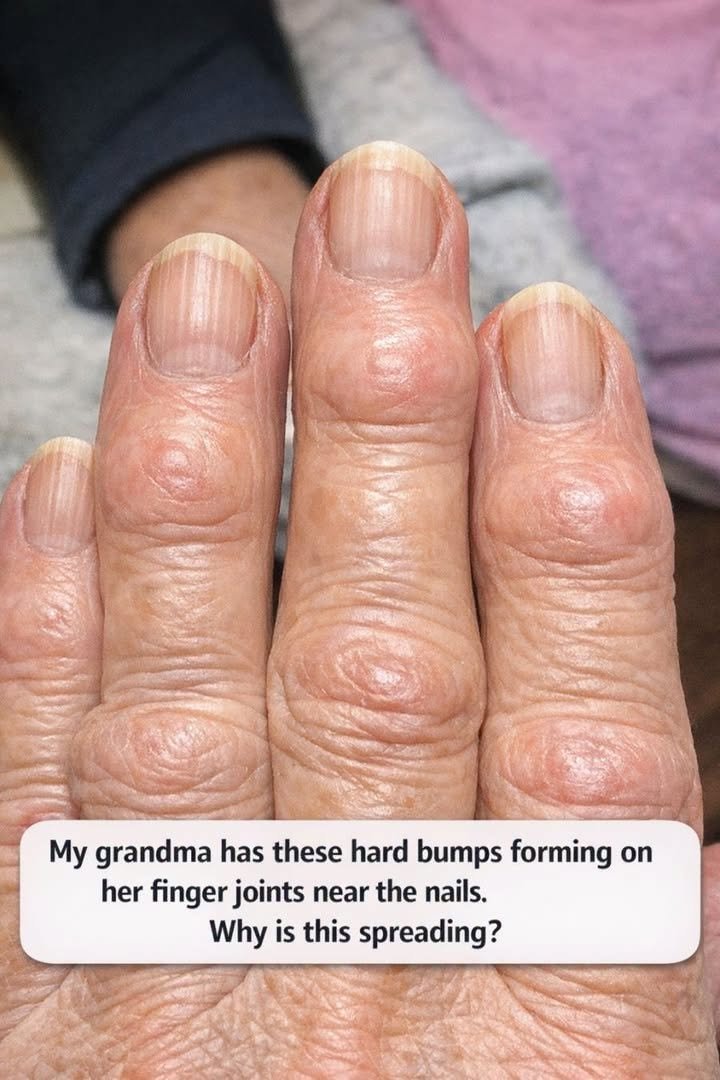
When hard bumps form on the finger joints near the nails, they are very often related to underlying wear-and-tear in the joint itself—a condition called hand osteoarthritis.
If your grandmother is noticing multiple bumps or feels like they are “spreading” across her fingers, it is usually because osteoarthritis tends to affect joints symmetrically or across multiple digits over time.
Two common culprits typically explain what is happening:
1. Heberden’s Nodes (Bony Spurs)
-
What they are: These are hard, bony enlargements that form directly on the distal interphalangeal (DIP) joints—the joint closest to the fingertip and nail.
-
Why they happen: As the smooth cartilage inside the joint gradually wears down over the years, the body responds by producing extra bone at the edges of the joint. These bony spurs are the hard lumps you can see and feel.
-
Why it feels like they are spreading: Hand osteoarthritis frequently runs in families and commonly develops across multiple fingers on both hands. As the natural degenerative process progresses, nodes often appear on one finger first and later show up on adjacent fingers.
2. Digital Mucous Cysts (Fluid-Filled Bumps)
-
What they are: Sometimes, a small, smooth, shiny, or translucent bump forms right near the base of the fingernail. This is a mucous cyst (a type of ganglion cyst), which is directly connected to an underlying arthritic joint. They are filled with a thick, jelly-like fluid.
-
Why it looks like it’s spreading: Because they share the same root cause as Heberden’s nodes (joint inflammation and cartilage wear), a person experiencing joint changes may develop a cyst on one finger, and eventually others, as the joint capsules experience micro-pressure. (Note: Never try to pop or squeeze a mucous cyst at home, as this can introduce bacteria directly into the joint and cause a severe infection).
What Can Be Done?
While these bony nodes and associated cysts cannot be reversed or “cured” with creams or home remedies, they can be managed effectively:
-
Manage Inflammation: During active flare-ups when the joints feel tender, warm, or swollen, gentle heat therapy or topical anti-inflammatory gels can help ease discomfort.
-
Protect the Joints: Maintaining gentle, daily movement through low-impact hand exercises keeps the fingers mobile, while avoiding heavy, painful pinching motions protects the cartilage from further strain.
A primary care physician or a rheumatologist can easily confirm whether these bumps are Heberden’s nodes or mucous cysts with a quick physical examination, and recommend the best ways to keep her hands comfortable and functional.
