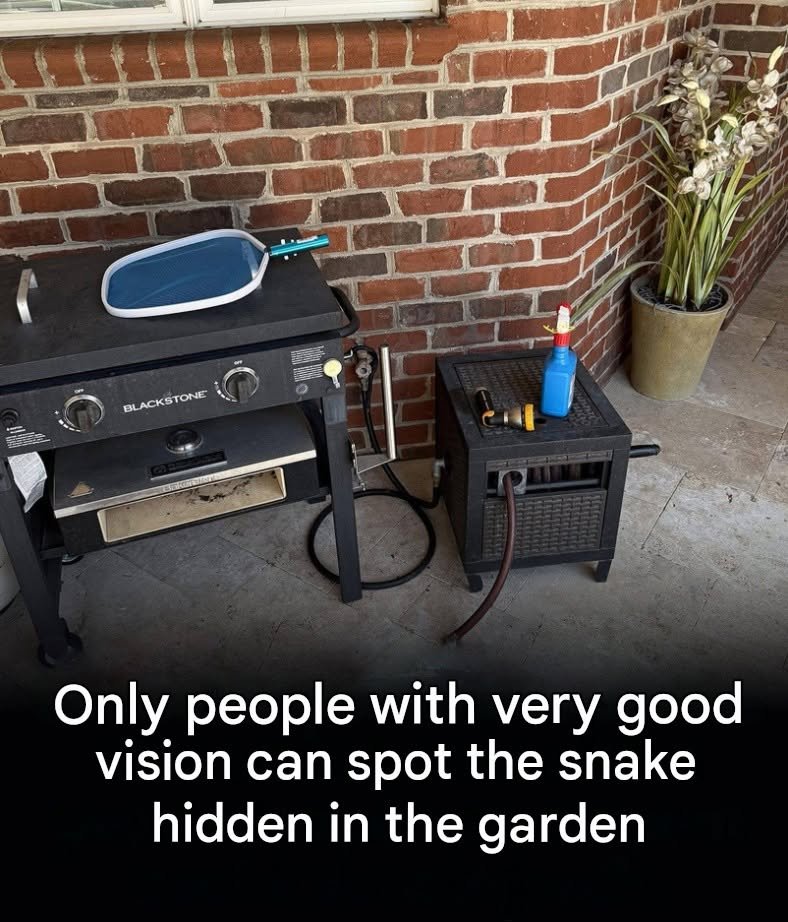
While visual puzzles and optical illusions featuring hidden reptiles embedded in architectural facades or stone masonry often circulate as viral tests of perception, they rely entirely on the fascinating biological mechanics of disruptive coloration and homochromy (matching background coloration).
When a gecko, agamid lizard, or snake takes up residence against a textured stone, brick, or stucco wall, its survival depends on merging completely with the structural patterns of its environment.
The Science of Architectural Camouflage
Reptiles that inhabit vertical stone structures employ several distinct evolutionary strategies to fool both human observers and predatory birds:
-
Disruptive Outlining: Instead of trying to look invisible, their skin features irregular blotches, bands, or speckles that break up their true silhouette. These patterns mimic the dark mortar lines, mineral deposits, and weathering cracks found on masonry.
-
Skin Texture and Tubercles: Many wall-dwelling geckos and lizards possess granular scales, bumps (tubercles), or flattened bodies that cast minimal shadow. By pressing flat against a rough surface, they eliminate the telltale three-dimensional shadow that would normally give away a foreign object.
-
Physiological Color Change (Parabiosis): Certain species can darken or lighten their skin pigmentation over several hours or days to match a freshly whitewashed wall, red brick, or dark grey slate.
How to Spot the Hidden Inhabitant in “Record Time”
If you are staring down a stubborn visual test where a reptile is cleverly concealed within a complex facade, bypass the urge to look for the whole animal right away. Instead, scan for these specific giveaways:
-
The Symmetrical Breach: Brickwork, stonework, and architectural facades follow rigid geometric grids, repeating patterns, or random natural fractures that never feature bilateral symmetry. If you spot a shape that features a balanced head, paired eyes, or a tapering tail, your brain has found a living organism.
-
The Catchlight (Eye Reflection): Stone, mortar, and concrete do not reflect specular light sharply. If a tiny point of light catches a moist, perfectly round or vertical-slit pupil, look right there—the eye is almost always the first thing to betray a camouflaged reptile.
-
Unnatural Geometry of Curves: Stone and brick are jagged, angular, or blocky. A smooth, fluid curve—such as the arch of a back, the bend of a knee, or a neatly coiled tail—contrasts sharply with the linear rigidity of masonry.
-
Micro-Shadows: Even when a lizard is pressed flat against a wall, the exact interface where its underside meets the rough surface creates a razor-thin, unbroken shadow line that differs from the chaotic shadows cast by deep crevices in the stone.
The Takeaway
Whether you are testing your observation skills on a digital puzzle or inspecting an old garden wall in the Mediterranean, finding a hidden reptile is an exercise in pattern disruption. By training your eyes to look for biological symmetry and specular eye reflections amid chaotic background textures, you can spot nature’s master illusionists in seconds.
