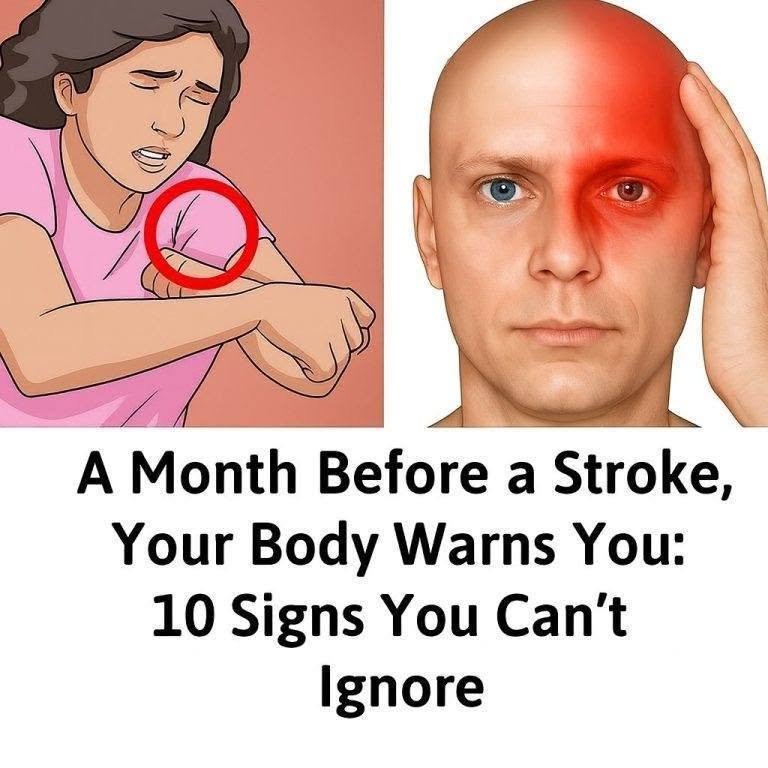
While a major stroke strikes suddenly, the body often sends early warning signals days or weeks in advance. These temporary symptoms are frequently caused by a Transient Ischemic Attack (TIA), often called a “mini-stroke.” A TIA occurs when blood flow to a portion of the brain is briefly blocked by a small clot before dissolving naturally.
Ignoring a TIA is a critical mistake: roughly 1 in 3 people who experience a TIA go on to have a full stroke, often within days or weeks.
10 Early Warning Signs Not to Ignore
-
Transient Sudden Numbness or Weakness: Brief loss of strength or sensation on one side of your body, face, arm, or leg.
-
Temporary Facial Droop: One side of your mouth or eye sags slightly when smiling or talking, even if it resolves within minutes.
-
Transient Speech Changes: Sudden difficulty articulating words, temporary slurring, or struggling to comprehend a simple spoken sentence.
-
Sudden Loss of Balance or Coordination: Sudden unsteadiness, unexplained stumbling, or loss of fine motor skills in one hand.
-
Brief Unexplained Dizziness or Vertigo: A sudden sensation that the room is spinning around you, often paired with nausea.
-
Sudden Vision Changes in One Eye: Temporary partial or total loss of sight in one eye (often described as a shade pulled over your view) or sudden double vision.
-
Sudden, Severe “Thunderclap” Headache: A sudden, intense headache with no clear cause, often signaling vascular stress or small bleed warnings.
-
Unexplained Confusion or Memory Gaps: Sudden disorientation regarding the time, location, or familiar routines.
-
Difficulty Swallowing (Dysphagia): Sudden choking on liquids or food due to temporary nerve impulse disruptions in throat muscles.
-
Sudden, Unexplained Extreme Fatigue: Sudden onset of severe drowsiness or muscle exhaustion paired with cognitive fog.
TIA vs. Acute Stroke Comparison
| Feature | Transient Ischemic Attack (TIA) | Acute Ischemic Stroke |
| Blood Flow Blockage | Temporary (clot dissolves on its own) | Persistent (clot stays in place) |
| Duration of Symptoms | Few minutes up to 24 hours (usually under 1 hour) | Permanent unless treated immediately |
| Brain Tissue Damage | No permanent structural tissue necrosis | Rapid cellular death (2 million neurons lost/minute) |
| Immediate Medical Need | High Emergency: Requires urgent workup to prevent full stroke | Critical Emergency: Requires immediate ER care/clot-busters |
The Emergency Protocol: Act F.A.S.T.
If any of these signs appear—even if they completely disappear after 5 minutes—do not wait to see if they return. Remember the F.A.S.T. protocol:
-
F – Face: Ask the person to smile. Does one side of the face droop?
-
A – Arms: Ask them to raise both arms. Does one arm drift downward?
-
S – Speech: Ask them to repeat a simple phrase. Is speech slurred or strange?
-
T – Time: If you observe any of these signs, call emergency services immediately.
Critical Warning: Never attempt to drive yourself or a family member to the hospital if you suspect a TIA or stroke. Call emergency services so paramedics can initiate life-saving neuro-protective care en route.
