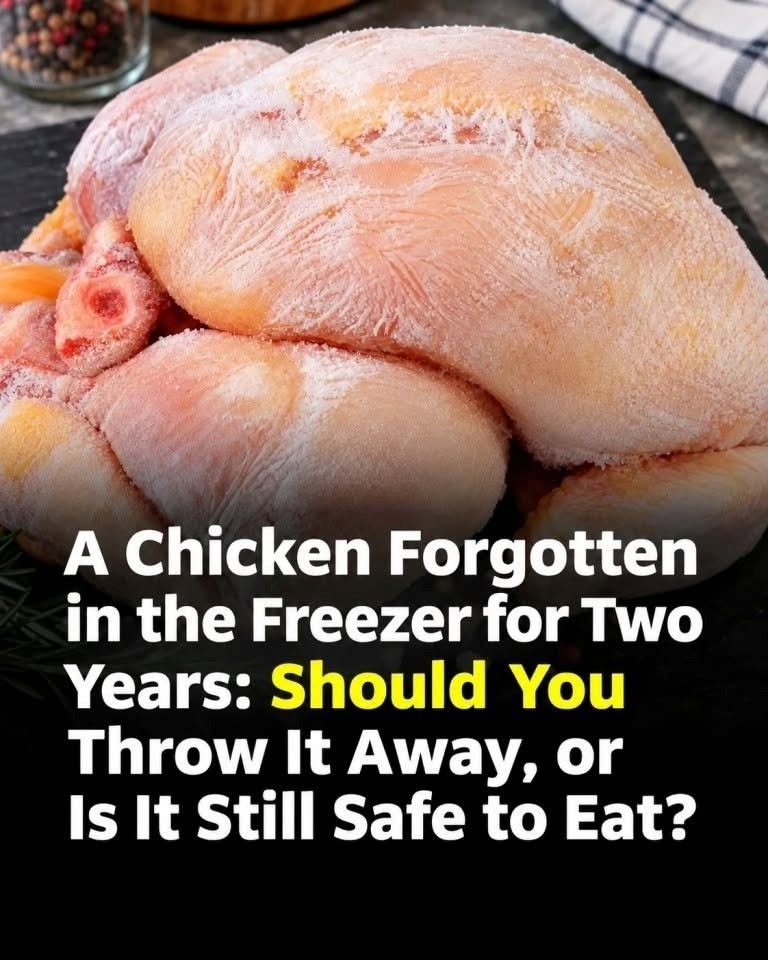
From a food safety standpoint, frozen chicken stored continuously at $0^\circ\text{F}$ ($-18^\circ\text{C}$) or below remains safe to eat indefinitely. Bacteria, yeasts, and molds cannot grow at freezer temperatures.
However, from a culinary quality standpoint, a two-year freeze almost certainly causes significant texture and flavor degradation due to moisture loss and fat oxidation.
Quality vs. Safety Matrix
| Evaluation Factor |
2-Year Frozen Chicken Status |
Clinical / Culinary Impact |
| Microbial Safety |
Safe (if stored continuously at $0^\circ\text{F}$) |
Pathogens are dormant; no bacterial growth occurs. |
| Freezer Burn |
Likely High |
Moisture sublimates, leaving tough, dry, discolored white/brown patches. |
| Fat Oxidation |
Moderate to High |
Lipids break down over time, creating a stale or cardboard-like off-flavor. |
| Meat Texture |
Degraded |
Muscle fibers dry out, resulting in a stringy or woody texture upon cooking. |
Inspection & Decision Protocol
1.Verify Continuous Freezing History:
Confirm the chicken remained continuously frozen at $0^\circ\text{F}$ ($-18^\circ\text{C}$). Discard immediately if it experienced prolonged power outages, partial thawing, or temperatures above $40^\circ\text{F}$ ($4^\circ\text{C}$).
2.Perform a Visual Inspection:
Examine the packaging and meat. Severe freezer burn shows up as dry, leathery, gray-brown patches. If only small spots are affected, trim them off after thawing; if the entire bird is freezer-burned, throw it away.
3.Thaw Under Refrigeration Only:
Thaw the chicken in the refrigerator for 24–48 hours. Never thaw on the counter at room temperature.
4.Perform the Aroma and Tactile Test:
Once thawed, smell the meat and feel its surface. Discard immediately if you detect any sour, ammonia-like odor or a slimy/tacky film (signs of spoilage prior to freezing or during temperature fluctuations).
5.Use Moistered Culinary Methods:
If the meat smells normal but appears dry, do not roast or grill it. Use slow-cooking methods with liquid—such as braising, stews, soups, or shredded chicken tacos—to mask moisture loss and tough fibers.