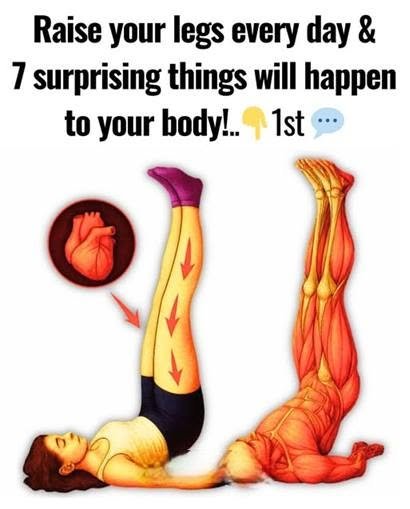
Viral fitness posts and online health trends frequently promise dramatic transformations with headlines like “Raise your legs every day & 7 surprising things will happen to your body!”—often claiming this simple posture will rapidly purge toxic waste, instantly cure insomnia, or melt abdominal fat.
In cardiovascular physiology and physical therapy, lying on your back and elevating your legs above your heart (often called the “Legs-Up-the-Wall” pose or Viparita Karani) does not perform miracle cures. However, using gravity to assist your circulatory system produces immediate, measurable physical effects.
Here is an objective, science-based breakdown of the 7 physiological changes that actually happen in your body when you elevate your legs daily:
1. Accelerated Venous Blood Return to the Heart
-
The Mechanism: Your leg veins contain one-way valves that work against gravity to pump oxygen-depleted blood back up toward your heart. Standing or sitting for extended periods causes blood to pool in the lower extremities.
-
What Happens: Elevating your legs above the level of your heart removes the gravitational burden on your veins. Venous blood glides smoothly back to the right atrium of the heart, improving overall venous return and reducing cardiac workload.
2. Reduction of Lower Extremity Swelling (Edema)
-
The Mechanism: Prolonged standing or sitting increases hydrostatic pressure inside the capillaries of your feet, ankles, and calves, causing fluid to leak into surrounding tissues (dependent edema).
-
What Happens: Reversing the gravitational gradient lowers capillary pressure in the legs. This allows excess interstitial fluid to be reabsorbed into the lymphatic system and blood vessels, visibly deflating swollen ankles and relieving heavy, tired legs.
3. Shift Toward Parasympathetic “Rest and Digest” Mode
-
The Mechanism: Elevating the legs while lying flat on your back lowers heart rate and prompts deep, diaphragmatic breathing.
-
What Happens: This comfortable, low-effort posture stimulates the vagus nerve, shifting your autonomic nervous system away from the sympathetic (“fight-or-flight”) response and into parasympathetic dominance. This lowers systemic blood pressure, slows your pulse, and promotes mental relaxation.
4. Decompression of the Lower Back (Lumbar Spine)
-
The Mechanism: Sitting all day keeps the hip flexors (psoas muscles) in a shortened, tight position, which pulls on the lumbar spine and exacerbates lower back stiffness.
-
What Happens: Lying flat with elevated legs (especially when bent at a 90-degree angle on a chair or couch) flattens the lumbar curve against the floor. This relaxes tight hip flexors and releases pressure on the lower spinal discs, providing rapid mechanical relief for lower back tension.
5. Improved Digestive Motility
-
The Mechanism: Elevated parasympathetic tone directly stimulates gastrointestinal peristalsis—the rhythmic muscular contractions that move food and gas through the digestive tract.
-
What Happens: By relieving physical stress and easing abdominal muscle tension, leg elevation aids digestion, helps relieve trapped gas, and reduces bloating.
6. Prevention and Management of Varicose Vein Symptoms
-
The Mechanism: Varicose veins occur when small valves inside lower leg blood vessels weaken, leading to chronic venous congestion and vessel enlargement.
-
What Happens: Daily elevation prevents chronic high pressure from damaging these delicate venous valves further. While it cannot erase existing, structurally damaged varicose veins, it significantly reduces the throbbing, aching, and heaviness associated with venous insufficiency.
7. Faster Post-Workout Muscle Recovery
-
The Mechanism: Intense exercise causes temporary micro-trauma, localized inflammation, and metabolic waste accumulation in leg muscle tissue.
-
What Happens: Elevating the legs speeds up the clearance of metabolic byproducts and inflammatory fluids from muscle beds while encouraging fresh, oxygenated arterial blood to recirculate through the legs once you stand back up.
How to Do It Safely
To get the physiological benefits without strain:
-
Lie flat on your back on a yoga mat or bed.
-
Prop your legs up on a wall, a stack of pillows, or the arm of a couch so your feet are higher than your chest.
-
Keep a slight bend in your knees if your hamstrings feel tight.
-
Hold the position comfortably for 10 to 15 minutes while taking slow, deep breaths.
Note: Individuals with severe unmanaged high blood pressure, congestive heart failure, or glaucoma should check with their physician before hanging out in inverted postures for extended periods.
