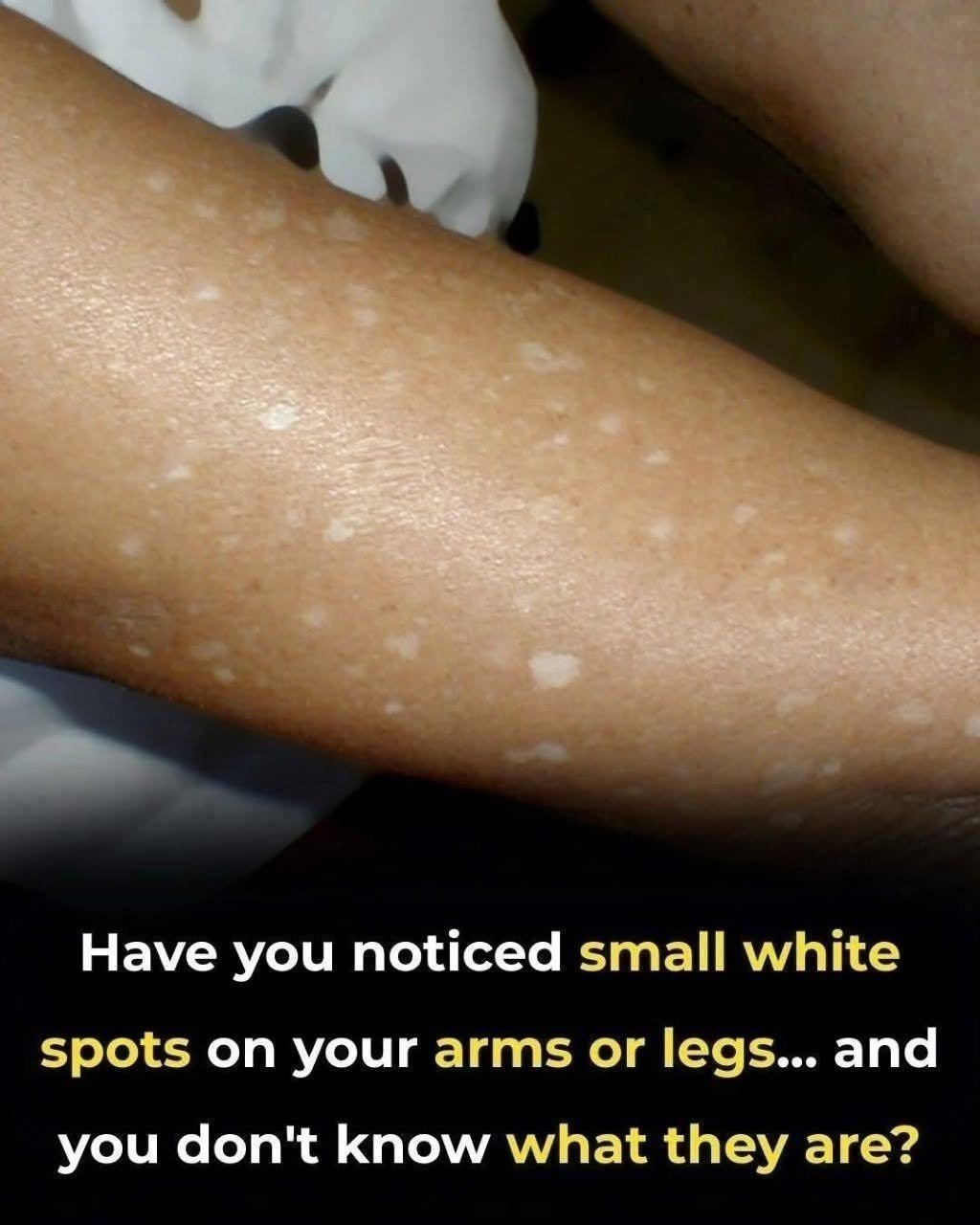
Articles with urgent hooks like “Small White Spots on Arms and Legs You Need To Know” often use dramatic phrasing to describe a phenomenon that is actually quite common. While clickbait frames these spots as a cryptic warning sign, dermatologists and clinical specialists look at them through an anatomical and diagnostic lens to separate harmless skin variations from conditions that require medical care.
The Most Common Culprit: Idiopathic Guttate Hypomelanosis (IGH)
If you notice tiny, flat, porcelain-white or pale spots—often looking like small drops of confetti—concentrated primarily on your shins and forearms, you are likely looking at Idiopathic Guttate Hypomelanosis (IGH).
-
What It Means: “Idiopathic” means the exact cause is unknown, “guttate” means drop-like, and “hypomelanosis” means a local lack of melanin (skin pigment).
-
The Cause: Dermatologists view IGH largely as a benign sign of cumulative sun exposure and aging. Over decades, UV radiation can gradually wear down or exhaust the melanocytes (pigment-producing cells) in specific tiny areas of skin.
-
Is It Dangerous? No. IGH is entirely benign, non-cancerous, asymptomatic (it doesn’t itch or hurt), and does not spread like an infection. It is primarily a cosmetic characteristic that tends to become more visible as people age or when surrounding skin gets a tan.
Other Medical Causes of White Spots on Limbs
While IGH is the most frequent reason for small dots on the arms and legs, dermatologists differentiate several other conditions that cause hypopigmentation:
1. Tinea Versicolor (A Common Fungal Overgrowth)
-
The Presentation: These patches can look white, pink, or light brown, and they are often accompanied by very mild scaling or itching.
-
The Cause: It is caused by an overgrowth of yeast (Malassezia) naturally living on the skin, typically triggered by heat, humidity, or heavy sweating. Unlike IGH, it is easily treated with antifungal washes or creams.
2. Vitiligo
-
The Presentation: Vitiligo produces smoother, often larger patches of complete depigmentation (milk-white skin) that tend to have distinct borders and can expand over time.
-
The Cause: This is an autoimmune condition where the body’s immune system mistakenly attacks and destroys the skin’s pigment cells. It frequently affects areas like the hands, knees, elbows, and around body openings.
3. Pityriasis Alba
-
The Presentation: This condition often leaves pale, slightly dry, or scaly patches on the skin, particularly in children and young adults.
-
The Cause: It is closely linked to mild eczema or skin inflammation, where the healing process temporarily strips the skin of its normal pigment.
Managing and Protecting Your Skin
Because most small white spots—especially IGH—are harmless, they do not medically require treatment. However, if you choose to address them for cosmetic reasons, dermatology offers several options:
-
Sun Protection: Regular use of broad-spectrum sunscreen won’t restore lost pigment, but it prevents the surrounding skin from tanning further, reducing the contrast and protecting your skin from UV damage.
-
Dermatological Procedures: For patients bothered by appearance, treatments like topical retinoids, mild steroids, cryotherapy (freezing), or laser therapy are sometimes used to stimulate skin renewal.
The Medical Takeaway: Finding small white spots on your arms and legs is usually a normal part of skin aging and sun history. However, if spots begin to change rapidly, itch persistently, become inflamed, or look irregular, a quick evaluation by a dermatologist can provide an accurate diagnosis and peace of mind.
Are you noticing small spots like these on your arms or legs, or tracking down a specific skin concern?
