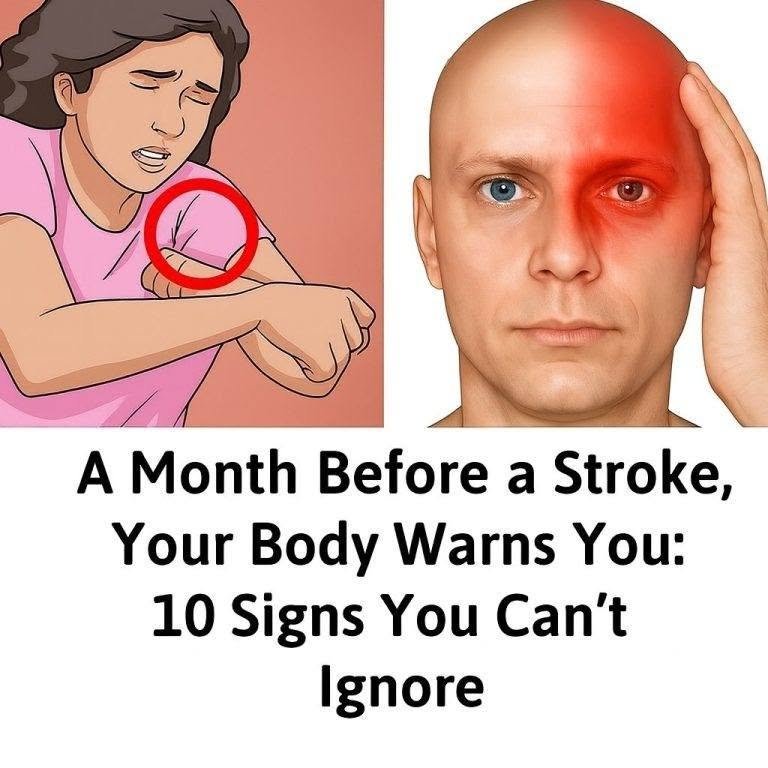
While major strokes often strike suddenly and without warning, many individuals experience subtle or transient red flags in the days and weeks leading up to a major event.
Most notably, these can include symptoms of a Transient Ischemic Attack (TIA)—often called a “mini-stroke”—where blood flow to the brain is temporarily blocked. Because TIA symptoms typically resolve within a few minutes to an hour, they are dangerously easy to dismiss. However, medical research shows that a significant percentage of major strokes are preceded by these smaller warning windows.
Here are 10 bodily signs—ranging from intermittent early warnings weeks in advance to acute pre-stroke signals—that should never be ignored:
1. Transient Numbness or Weakness (Especially One-Sided)
-
What it feels like: Brief, sudden episodes of weakness, tingling, or numbness in your face, arm, or leg—frequently affecting only one side of the body. You might suddenly find it hard to hold a coffee mug or notice an arm drifting downward.
-
Why it happens: Temporary reductions in blood flow to localized areas of the brain motor cortex.
2. Brief Episodes of Slurred or Garbled Speech
-
What it feels like: Struggling to get words out, slurring your speech, or finding yourself completely unable to understand what someone else is saying, even if it lasts for only 5 or 10 minutes.
-
Why it happens: A temporary disruption in the brain’s language centers, signaling arterial narrowing or intermittent clotting.
3. Sudden, Unexplained Vision Changes
-
What it feels like: Sudden blurring, double vision, or a temporary loss of vision in one eye (sometimes described as a shade or curtain pulling down over your field of vision).
-
Why it happens: Reduced blood flow to the optic nerve or the visual cortex in the brain.
4. Unexplained Dizziness and Loss of Balance
-
What it feels like: Sudden bouts of vertigo, feeling lightheaded, stumbling, or losing coordination while walking without any inner ear infection or apparent cause.
-
Why it happens: Disruption in the areas of the brain (like the cerebellum) responsible for spatial coordination and balance.
5. Severe, “Thunderclap” Headaches
-
What it feels like: A sudden, exceptionally severe headache unlike any ordinary migraine or tension headache, often hitting without a clear trigger and sometimes accompanied by stiffness or confusion.
-
Why it happens: Can indicate pressure shifts, micro-bleeding, or a compromised blood vessel within the brain.
6. Sudden Cognitive Fog or Confusion
-
What it feels like: Feeling unusually disoriented, struggling to follow a basic conversation, forgetting familiar words, or experiencing sudden short-term memory lapses.
-
Why it happens: Portions of the brain are temporarily starved of the continuous oxygen supply required for normal cognitive processing.
7. Unexplained, Pervasive Fatigue
-
What it feels like: A deep, sudden exhaustion or lethargy that doesn’t improve with sleep, making basic daily tasks feel overwhelmingly heavy.
-
Why it happens: While fatigue is common to many conditions, a sudden onset can indicate that the cardiovascular and neurological systems are under severe systemic stress.
8. Subtle Mood or Behavioral Shifts
-
What it feels like: Uncharacteristic bouts of irritability, sudden anxiety, depression, or emotional volatility that seem to come out of nowhere.
-
Why it happens: Neurological stress or minor micro-vascular events affecting the emotional centers of the brain.
9. Difficulty Swallowing (Dysphagia)
-
What it feels like: A sudden, mild sensation of food catching in your throat, or choking unexpectedly on liquids.
-
Why it happens: Early disruption to the cranial nerves that control the intricate muscles of the throat and mouth.
10. Brief “Drop Attacks” or Faintness
-
What it feelsLike: Sudden, momentary buckling of the knees or a fleeting sensation that you are about to pass out, clearing up almost as quickly as it started.
-
Why it happens: Temporary drops in cerebral perfusion (blood flow to the brain stem).
The Golden Rule: Remember B.E. F.A.S.T.
If you or someone around you experiences any sudden stroke symptoms—even if they seem to vanish after a few minutes—it should be treated as a medical emergency. Use the B.E. F.A.S.T. mnemonic to check for an active crisis:
-
B – Balance: Is there a sudden loss of balance or coordination?
-
E – Eyes: Is there sudden trouble seeing?
-
F – Face: Does one side of the face droop when smiling?
-
A – Arms: Does one arm drift downward if both are raised?
-
S – Speech: Is speech slurred or strange?
-
T – Time: Time to call emergency services immediately. Never wait to see if early warning signs “wear off”.
