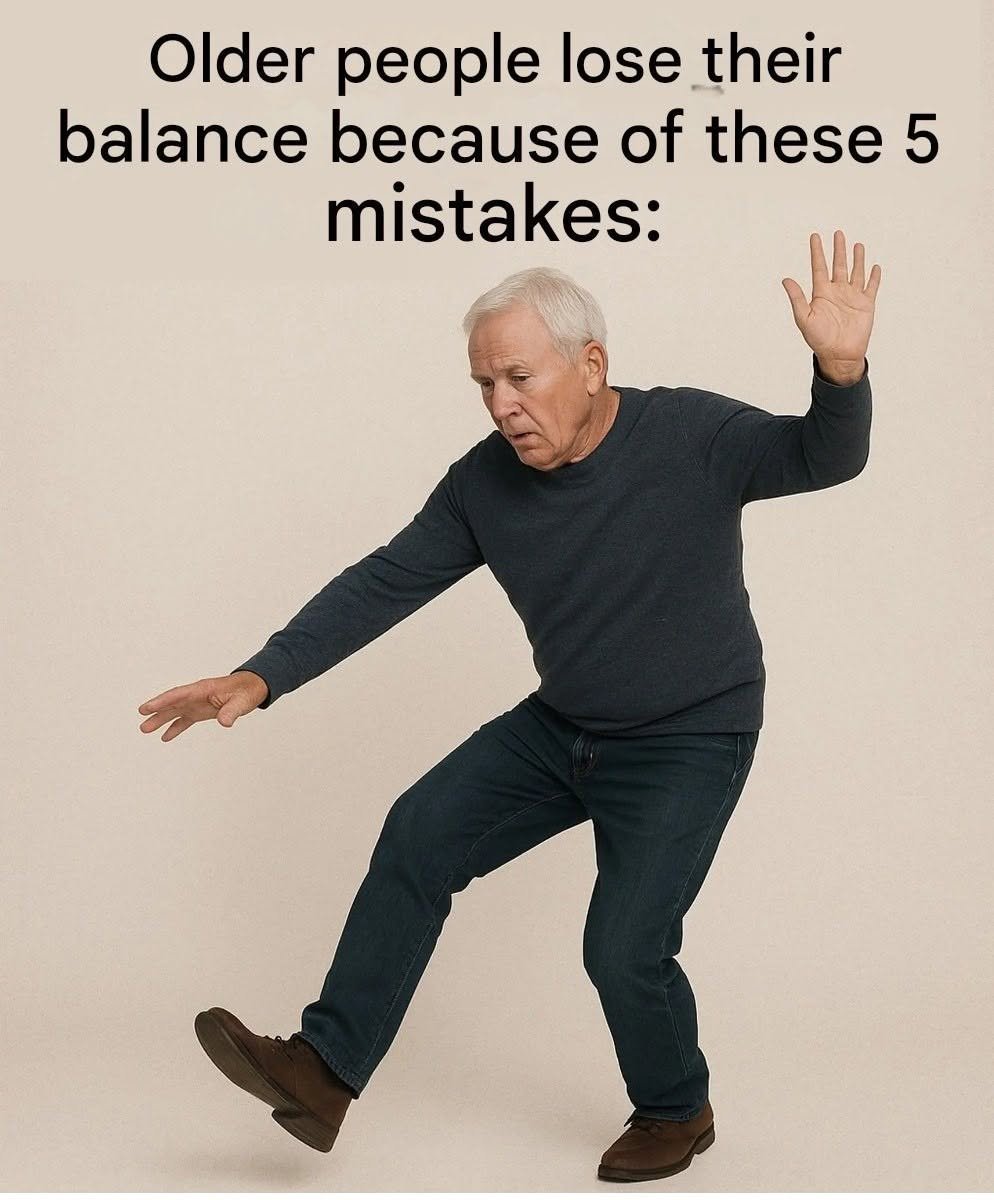
Maintaining steady balance as we age is vital for preventing falls and preserving long-term independence. While age-related changes do play a role, many balance issues stem from everyday habits and oversights that can easily be corrected.
Here are 5 common mistakes that contribute to balance loss in older adults, along with how to fix them:
1. Neglecting Strength Training in the Lower Body
-
The Mistake: Relying solely on walking or light aerobic activity while completely skipping resistance training. Walking is fantastic for cardiovascular health, but it doesn’t build the specific muscle power needed in your quads, hips, and calves to catch yourself if you start to trip.
-
The Fix: Incorporate simple, functional strength exercises twice a week—such as sit-to-stands (chair squats) and heel raises—to keep your major lower-body muscle groups strong.
2. Wearing Unsupportive Footwear Indoors
-
The Mistake: Walking around the house barefoot, in loose slippers, or in worn-out socks with no grip. As we age, sensation in the soles of the feet naturally decreases, meaning your brain relies heavily on physical feedback from your shoes or floor to understand where your body is in space.
-
The Fix: Wear supportive, flat, non-slip shoes or slippers with textured rubber soles even when walking around inside your home.
3. Failing to Train Balance Specifically (The “Use It or Lose It” Rule)
-
The Mistake: Assuming that standing and walking are enough to maintain balance reflexes. Balance is a neurological skill involving your inner ear, vision, and proprioception (body awareness), and it deteriorates if it isn’t intentionally challenged.
-
The Fix: Practice simple balance drills daily, such as standing on one leg while holding onto a kitchen counter for support, or practicing heel-to-toe (tandem) walking in a hallway.
4. Overlooking Vision and Hearing Changes
-
The Mistake: Putting off updating eyeglass prescriptions or ignoring mild hearing loss. Your inner ear houses your vestibular system (your body’s internal gyroscope), and your brain cross-references signals from your eyes, ears, and joints to keep you upright. When vision or hearing declines, your brain loses crucial spatial data.
-
The Fix: Get your eyes checked annually, ensure your glasses prescription is up to date, and have your hearing evaluated, as studies consistently link untreated hearing loss to an increased risk of falls.
5. Ignoring Environmental Hazards at Home
-
The Mistake: Living with hidden tripping hazards—such as unsecured area rugs, electrical cords across walkways, poor hallway lighting, or clutter on the stairs—because “you’ve lived there for decades and know where everything is.”
-
The Fix: Do a safety sweep of your home: anchor or remove loose throw rugs, ensure high-traffic pathways are completely clear, and install motion-activated nightlights between your bedroom and bathroom.
