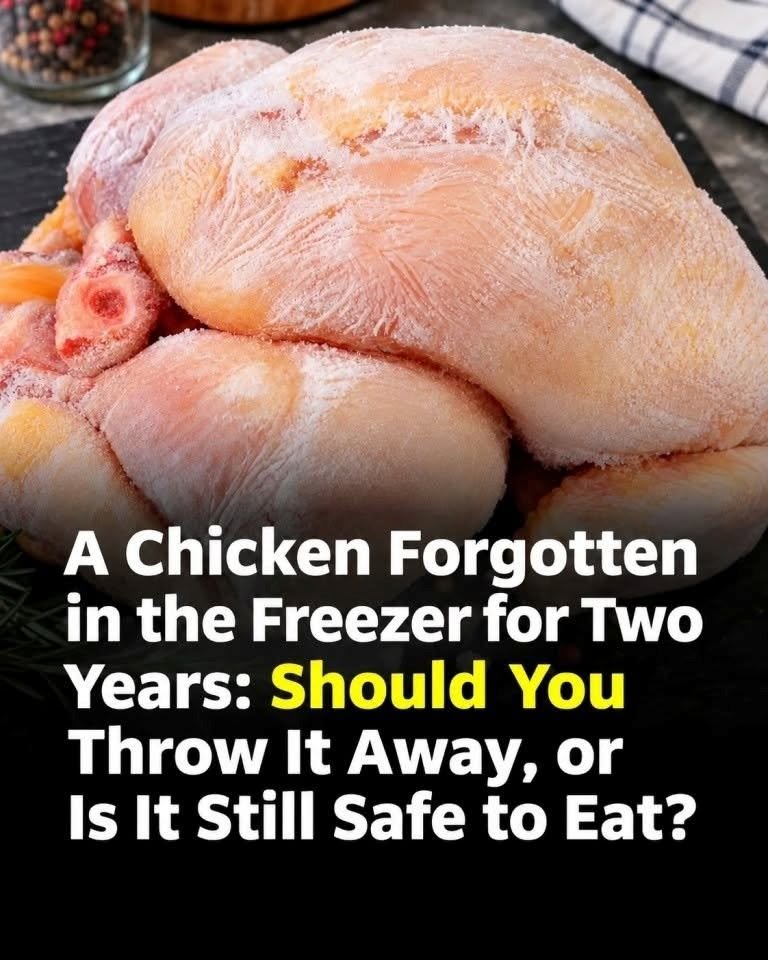
It can be saved—you do not need to throw it away purely for safety reasons.
According to the USDA, food kept continuously frozen at $0^\circ\text{F}\ (-18^\circ\text{C})$ or lower remains safe to eat indefinitely because bacteria and pathogens cannot grow in those conditions.
However, while it is safe, the quality (flavor, moisture, and texture) will have degraded significantly over two years.
Step 1: Safely Thaw & Inspect It
-
Thaw in the Fridge: Move the chicken to the refrigerator to thaw slowly over 24 to 48 hours. Never thaw it on the counter.
-
The Smell & Feel Test: Once thawed, smell the meat and feel its surface.
-
If it has a sour, putrid, or foul odor, or if it feels sticky or slimy, throw it away immediately (this indicates it was spoiled before freezing or thawed partially at some point).
-
If it smells like typical raw chicken (or slightly stale/freezer-burnt) and isn’t slimy, it is safe to cook.
-
Step 2: How to “Save” 2-Year-Old Frozen Chicken
1. Trim away the freezer burn
Moisture loss over 24 months creates dry, leathery, white or greyish-brown patches on the meat. Use a sharp knife to cut away these dry areas completely, as they hold a stale, cardboard-like flavor.
2. Don’t roast or grill it straight
Cooking it like a fresh breast or thigh will result in dry, tough, stringy meat.
3. Use moisture-heavy, highly seasoned recipes
Disguise the lost texture and natural flavor by using the chicken in slow-cooked or saucy dishes:
-
Shredded Chicken Tacos or Enchiladas: Simmer low and slow in a slow cooker with chicken broth, taco seasoning, and salsa, then shred.
-
Soups & Stews: Simmer in a chicken soup, chili, or chicken pot pie filling where liquid keeps the meat moist.
-
Curries & Sauces: Use in a rich Butter Chicken, Tikka Masala, or curry where heavy spices mask any slight freezer-burn taste.
-
Brining: Soak the meat in a salt-water brine (¼ cup salt per 4 cups water) for 2 to 4 hours before cooking to help force moisture back into the dried muscle fibers.
