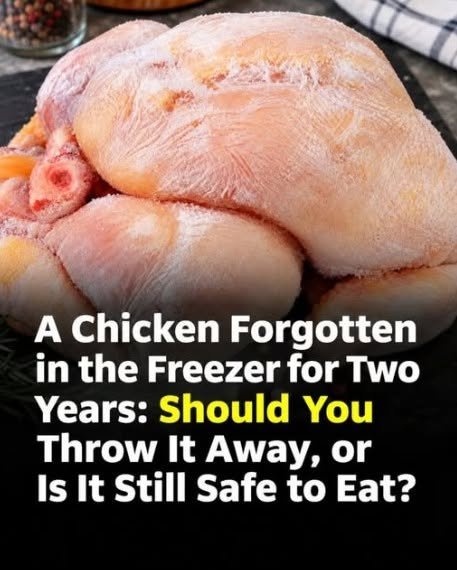
When home cooks discover a forgotten package of chicken buried deep in the freezer that has been sitting there for two years, the immediate instinct is often to throw it straight into the trash, assuming it has turned toxic or spoiled.
In food science and culinary reality, the safety of long-frozen meat is governed by a clear distinction between microbiological safety and organoleptic quality (taste, texture, and moisture).
What Freezer Food Myths Get Wrong
-
The “Expiration Date Clock” Fallacy: People often assume that the “best-by” or packaging date keeps ticking down inside a sub-zero environment, eventually turning the meat into a biohazard.
-
The “Freezing Kills Spoilage” Confusion: On the flip side, some believe freezing sterilizes meat forever. In reality, freezing does not destroy existing bacteria or completely halt internal enzymatic activity; it merely puts them into a deep dormant state.
The Food Science Reality: Safety vs. Quality
Food safety authorities, including the USDA, outline two fundamental rules regarding frozen meat:
-
Safety is Indefinite at Sub-Zero Temperatures: As long as a freezer has been kept continuously at $0^\circ\text{F}$ ($-18^\circ\text{C}$) or lower, frozen chicken is safe to eat indefinitely. Because extreme cold halts microbial growth, bacteria cannot multiply, meaning a two-year-old chicken will not harbor foodborne pathogens because of the time spent frozen.
-
Quality Degrades Significantly Over Time: While safe, two years is far beyond the optimal window for poultry (the USDA recommends using raw chicken parts within 9 to 12 months for peak quality). Over months in a standard freezer, moisture slowly escapes through sublimation, and remaining fats oxidize when exposed to micro-pockets of air. This process causes freezer burn, leaving the meat dry, leathery, and structurally altered.
How to Evaluate and Cook a 2-Year-Old Chicken
If you are deciding whether to salvage a long-frozen bird, evaluate it through a practical, kitchen-science lens:
-
Inspect the Packaging and Surface: Check if the seal was airtight. If the plastic is torn, or if the chicken is blanketed in heavy ice crystals and exhibits chalky, gray-white patches of freezer burn, the outer cells have dried out completely.
-
Thaw Safely in the Refrigerator: Always thaw frozen meat slowly in the fridge (never on the counter). Once fully defrosted, check the texture and smell. If it exhibits a genuinely sour, rancid, or foul odor, discard it immediately.
-
Repurpose for Moisture-Rich, Slow-Cooked Dishes: Because a two-year freeze strips away natural juices, cooking the chicken plainly (such as grilling a dry breast) will result in a stringy, cardboard-like texture. Instead, salvage it by shredding or dicing it for long-simmered, heavily seasoned dishes—like chilis, chicken soups, curries, or enchiladas—where broths, sauces, and spices mask the textural loss.
The Bottom Line
Chicken frozen for two years will not make you sick simply due to age, provided it stayed solidly frozen the entire time. However, its quality, moisture, and flavor will have taken a heavy hit. Skip the food panic, inspect the package integrity upon thawing, and reserve it for a stew or soup if you choose to cook it.
