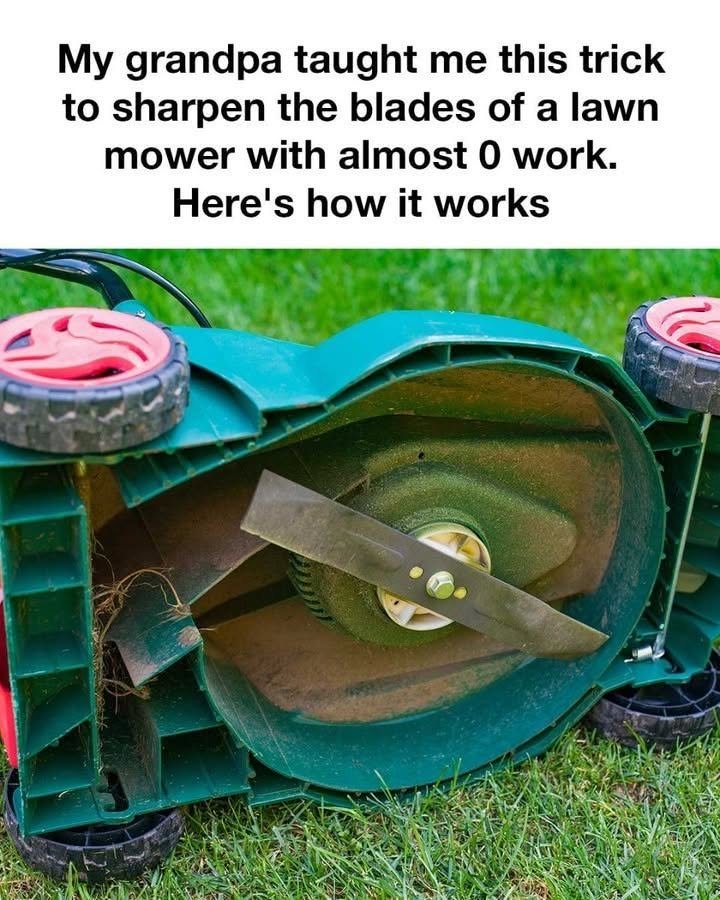
Viral videos and social media reels frequently feature “zero-effort” lawn mower blade sharpening tricks—often involving spraying blades with chemical solvents, running the mower over abrasive materials like sand or gravel, or rubbing a file over a blade without taking it off the mower deck.
While these viral hacks sound tempting, lawn mower blades require a specific, balanced bevel edge to cut grass safely and effectively. Shortcuts almost always ruin the blade or create serious safety hazards.
Here is an objective, mechanical breakdown of why popular “zero-work” sharpening tricks fail, the physics of grass cutting, and the safest way to actually maintain your mower blades:
The Reality Behind Popular “Zero-Work” Hacks
-
The “Sand/Gravel Driveway” Trick:
-
The Claim: Running a running mower over sand or small gravel “grinds” the blades sharp automatically.
-
The Mechanical Reality: Sand and gravel are unguided, aggressive abrasives. Instead of sharpening, they pit, chip, and dull the blade’s edge while blasting the mower deck’s underside and throwing high-speed projectile debris out of the discharge chute.
-
-
Sharpening Without Removing the Blade:
-
The Claim: Tilting the mower up and running a file or drill attachment along the edge saves time.
-
The Mechanical Reality: Sharpening a blade mounted to the engine crankshaft makes it nearly impossible to maintain a consistent angle. Worse, tilting a gas mower incorrectly can flood the air filter and carburetor with engine oil or fuel.
-
-
Chemical / Rust-Removal Sprays:
-
The Claim: Chemical dips “eat away” dull metal to reveal a sharp edge.
-
The Mechanical Reality: Solvents remove surface rust and debris, but they cannot restore folded, rounded, or gouged steel edges. Physical metal removal is required to restore an edge.
-
Why Blade Balance Matters (The Physics of Mowing)
Lawn mower blades spin at roughly 2,800 to 3,600 RPM (rotations per minute). At those speeds, the tips of the blade travel at over 150 miles per hour.
-
Severe Engine Vibration: If one side of the blade loses more metal than the other during an uneven sharpening trick, the blade becomes unbalanced. This creates an intense vibration that can destroy the engine’s main bearings, bend the crankshaft, or crack the deck housing.
-
Tearing vs. Cutting Grass: A dull or improperly bevelled blade doesn’t cut grass cleanly; it smashes and tears the tips of the grass blades. This leaves behind jagged, brown ends that make the lawn susceptible to disease, fungal infections, and dehydration.
The Proper (and Still Quick) Way to Sharpen Mower Blades
Restoring a blade properly takes only about 15 minutes and ensures both safety and lawn health:
-
Disconnect the Power (Safety First): Always pull the spark plug boot off (on gas mowers) or remove the battery/unplug the cord (on electric mowers) before touching the underside.
-
Remove the Blade: Block the blade with a piece of scrap wood to prevent it from spinning, then unbolt the retaining nut using a socket wrench.
-
Inspect and File: Clean off dried grass clippings. Use a bench grinder, an angle grinder with a flap disc, or a simple hand-held metal file to sharpen along the existing factory bevel (typically around a 30-degree angle). Avoid sharpening it to a razor-thin edge, which dulls immediately on grass; a butter-knife sharpness is ideal.
-
Balance the Blade: Hang the center hole of the blade on a nail driven into a wall or place it on a cone balancer. If one side dips, lightly file metal off that heavy side until the blade hangs level.
-
Reinstall: Reattach the blade with the bevelled side facing up toward the mower deck, and torque the bolt securely.
