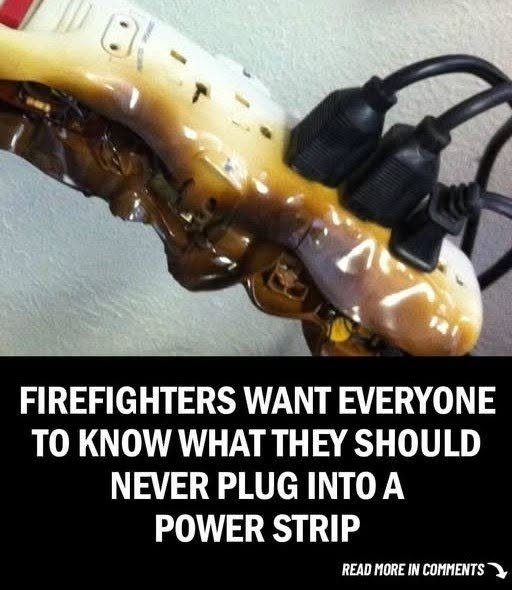
While power strips provide convenient extra outlets for low-wattage electronics like computers, lamps, and phone chargers, using them with heavy-duty or heat-generating devices is a major fire hazard. Standard power strips are generally designed to handle up to 1,800 watts total across all outlets—a limit easily breached by a single high-power device.
Here are the primary things you should never plug into a power strip:
1. Space Heaters and Portable Air Conditioners
-
Why: Space heaters and window/portable AC units draw continuous high current (often 1,500 watts or more). This sustained load can easily melt the internal wiring of a power strip or trigger an electrical fire. Electrical and fire safety codes require plugging these directly into a wall outlet.
2. Large Major Appliances (Refrigerators, Freezers, Washers, and Dryers)
-
Why: Appliances with heavy compressors or motors undergo sudden power surges when cycling on. A refrigerator or washing machine’s startup load can severely overload a strip, melt components, or damage the appliance.
3. High-Wattage Kitchen Appliances (Microwaves, Toasters, Air Fryers, and Coffee Makers)
-
Why: Any small kitchen appliance designed to quickly generate intense heat—including microwaves (1,000–1,500W), toasters, air fryers, toaster ovens, waffle irons, and drip coffee makers—draws near the maximum capacity of a power strip on its own. Combining them or running them through a strip frequently leads to severe overheating.
4. High-Heat Beauty Tools (Hair Dryers, Curling Irons, and Flat Irons)
-
Why: Personal care heating tools pull around 1,500 to 1,800 watts almost instantly. Used near bathroom sinks or damp counters, they also present an added shock risk if plugged into an ungrounded power strip rather than a GFCI wall outlet.
5. Another Power Strip or Extension Cord (“Daisy Chaining”)
-
Why: Plugging one power strip into another or connecting an extension cord to a power strip violates electrical safety codes (including NFPA and OSHA guidelines). It multiplies the potential electrical resistance and easily trick-overloads the primary wall outlet.
6. Sump Pumps and Wet-Environment Equipment
-
Why: Sump pumps require a heavy startup surge and operate in damp or flood-prone basement areas. Power strips are not sealed against moisture, creating an extreme risk of short circuits or electrocution. They must be plugged directly into elevated, dedicated GFCI outlets.
7. Heavy-Duty Power Tools (Saws, Air Compressors, and Drills)
-
Why: Workshop tools have high-amperage motors that create sharp startup spikes. Standard residential power strips are not built to handle these surges, which can trip circuit breakers or permanently ruin the strip.
8. Critical Medical Equipment (CPAP Machines, Oxygen Concentrators)
-
Why: Life-support or vital health devices require uninterrupted, stable power. Standard power strips can be accidentally switched off, easily knocked loose, or suffer minor voltage fluctuations that compromise the device’s function.
The Golden Rule
If an appliance generates heat, uses a cooling compressor, contains a heavy motor, or removes moisture, it belongs in a dedicated wall outlet. Power strips should be reserved for light electronics like TVs, computers, lamps, and low-power charging stations.
