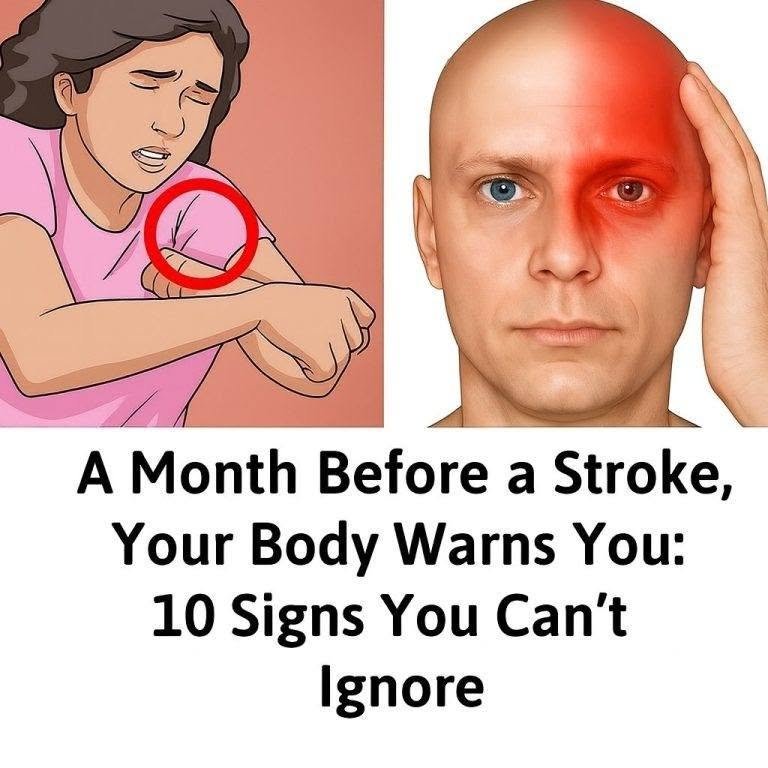
While a full-blown ischemic or hemorrhagic stroke often strikes suddenly, medical research shows that up to 15% to 20% of stroke victims experience preliminary warning signs days or even up to a month before the major event.
These early warning signs are frequently caused by Transient Ischemic Attacks (TIAs)—often called “mini-strokes”—or temporary micro-blockages that disrupt blood flow to the brain, resolve quickly, and are foolishly ignored as temporary fatigue. Recognizing these signals early gives you a vital window to seek emergency evaluation, begin preventive treatment, and prevent permanent brain damage.
Here are 10 early warning signs your body may give up to a month before a stroke:
1. Intermittent One-Sided Numbness or Weakness
-
The Warning Sign: Sudden weakness, tingling, or heaviness in the arm, leg, or side of your face—specifically localized to one side of the body. You might accidentally drop a coffee cup, find your leg suddenly giving out, or notice a hand feeling “asleep” for several minutes before returning to normal.
2. Sudden Speech Disturbances (Slurring or Aphasia)
-
The Warning Sign: Brief episodes where words sound garbled, slurred, or jumbled, or moments where you know what you want to say but physically cannot form the words. You may also find it temporarily difficult to comprehend what someone else is saying.
3. Temporary Vision Loss or Double Vision (Amaurosis Fugax)
-
The Warning Sign: Experiencing sudden dimness, blurred vision, or a temporary curtain-like loss of sight in one eye. This occurs when blood flow to the optic nerve or the visual processing center of the brain is briefly obstructed.
4. Unexplained Recurrent Headaches
-
The Warning Sign: Developing severe, unusual, or persistent headaches that don’t respond well to standard pain relievers. A stroke-related headache often comes on rapidly and may be localized to a specific area of the head due to arterial stiffness or micro-bleeding.
5. Unprovoked Dizziness or Sudden Vertigo
-
The Warning Sign: A sudden feeling that the room is spinning, persistent lightheadedness, or sudden loss of physical balance while walking. When blood flow to the cerebellum (the brain’s balance center) is compromised, spatial coordination drops immediately.
6. Profound, Unexplained Fatigue and Brain Fog
-
The Warning Sign: Waking up feeling completely exhausted despite getting adequate sleep, accompanied by sudden difficulty concentrating or carrying out routine daily tasks. When the brain receives reduced arterial oxygen, it struggles to maintain cognitive stamina.
7. Sudden Drop in Fine Motor Coordination
-
The Warning Sign: Suddenly becoming clumsy with your hands—such as struggling to button a shirt, tie shoelaces, hold a pen, or insert a key into a lock. Motor cortex signaling degrades when local brain perfusion is restricted.
8. Sudden Mood, Memory, or Behavioral Shifts
-
The Warning Sign: Experiencing unexpected bursts of irritability, sudden anxiety, confusion, or short-term memory lapses (like forgetting familiar routes home or common names). Micro-vascular changes in the frontal lobes can alter mood control and memory processing.
9. Difficulty Swallowing (Dysphagia)
-
The Warning Sign: Choking frequently on water or food, or feeling like food is sticking in your throat during routine meals. The brainstem controls basic automatic reflexes like swallowing; subtle disruptions can impair throat muscular coordination.
10. Brief Episodes of Facial Drooping or Asymmetry
-
The Warning Sign: A subtle, temporary sag on one side of your mouth or eye when you smile or speak. Even if the asymmetry resolves in under two minutes, it indicates temporary ischemia in the facial nerve pathways of the brain.
The Emergency Rule: Remember B.E. F.A.S.T.
If an active stroke or TIA is happening right now, every second counts to prevent irreversible brain tissue death:
-
B — Balance: Is the person experiencing sudden loss of balance or coordination?
-
E — Eyes: Is there sudden loss of vision or double vision in one or both eyes?
-
F — Face: Ask the person to smile. Does one side of the face droop?
-
A — Arms: Ask them to raise both arms. Does one arm drift downward?
-
S — Speech: Ask them to repeat a simple sentence. Is their speech slurred or strange?
-
T — Time: If you observe any of these symptoms, call emergency services immediately.
What to Do If You Notice Warning Signs
Even if these symptoms appear for just 5 minutes and disappear entirely, do not wait to see if they return. A TIA is a high-level medical emergency. Immediate medical evaluation via brain imaging (CT/MRI) and blood vessel scans can allow doctors to prescribe blood thinners, manage blood pressure, or perform minor arterial procedures before a massive stroke occurs.
