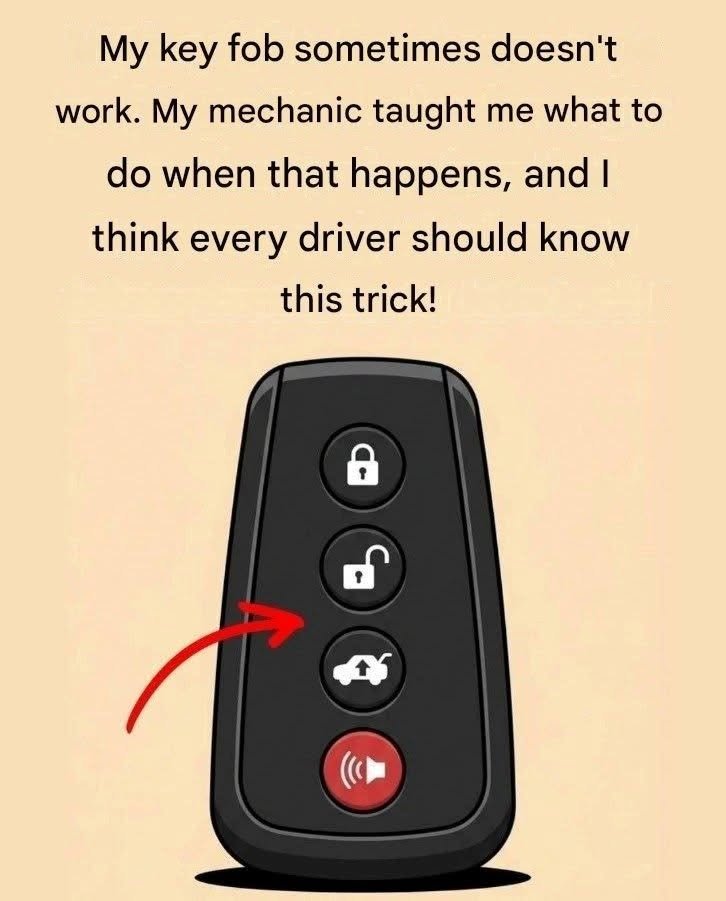
When your key fob suddenly stops responding, it is usually due to a dead battery, lost programming, or dirty internal contacts.
Here are practical hacks to unlock your car, get the engine started immediately, and fix the remote itself:
Emergency Hacks: How to Unlock & Start the Car Right Now
1. Use the Hidden Mechanical Key inside the Fob
Nearly all key fobs—even sleek push-to-start remotes—contain a hidden emergency metal key:
-
How to find it: Look for a tiny release switch or slider button on the back or side of the fob casing. Slide it and pull on the keychain loop to release the emergency physical key.
-
Where to insert it: If your driver’s door handle doesn’t show a keyhole, look at the plastic cap on the right end of the handle. There is usually a small slot underneath the cap; press your key into that slot to pop off the decorative plastic cover, revealing the hidden lock cylinder.
2. The “NFC / Passive RFID” Push-Start Hack
If your car has a push-to-start ignition button, you can still start the engine even if the fob battery is 100% dead:
-
Instead of using your finger, press the engine Start/Stop button directly with the key fob itself (or hold the key fob directly up against the button while pressing it with your finger).
-
Why it works: Car manufacturers place a passive RFID reader behind the start button (or inside a designated backup slot near the cup holder or steering column). The vehicle uses near-field communication to read the security chip inside the fob without needing any battery power from the remote.
DIY Maintenance Hacks: How to Fix the Key Fob
3. Clean the Internal Metal Contact Pads
Sometimes the battery isn’t dead—it’s just blocked by oxidation, dust, or oil from your skin.
-
Pry open the fob using a flathead screwdriver or coin.
-
Dip a cotton swab in rubbing alcohol (90%+ isopropyl) and clean the metal prongs, battery contacts, and rubberized button pads inside.
-
Let it dry completely before snapping the shell back together.
4. Bend the Battery Prongs Slightly
Over time, dropping the key fob or frequent button pushes can loosen the metal spring prongs that hold the battery flat against the circuit board.
-
Open the fob casing and remove the battery.
-
Use a small paperclip or tweezers to gently bend the tiny metal contact prongs upward so they press more tightly against the coin battery when reassembled.
5. Try the Manual Reprogramming Hack
If your key fob has fresh batteries but still won’t lock or unlock the doors, it may have lost its synchronization with the vehicle’s receiver.
Many vehicles (especially older Honda, Ford, Toyota, and Nissan models) allow you to re-pair the fob at home:
-
Get into the driver’s seat and lock all doors manually.
-
Insert your physical key into the ignition and turn it to the ON position (without starting the engine), then back to OFF.
-
Repeat this process 3 to 10 times in quick succession (depending on the make). On many models, the door locks will cycle automatically to confirm the car has entered “programming mode.”
-
Press the LOCK button on your key fob within 5 seconds to pair it.
Quick Prevention Tip
Most key fobs use standard CR2032 or CR2025 3V lithium coin cell batteries, which are readily available at grocery stores, pharmacies, and hardware shops. Taping a spare coin battery inside your glove compartment or wallet ensures you are never caught off guard.
