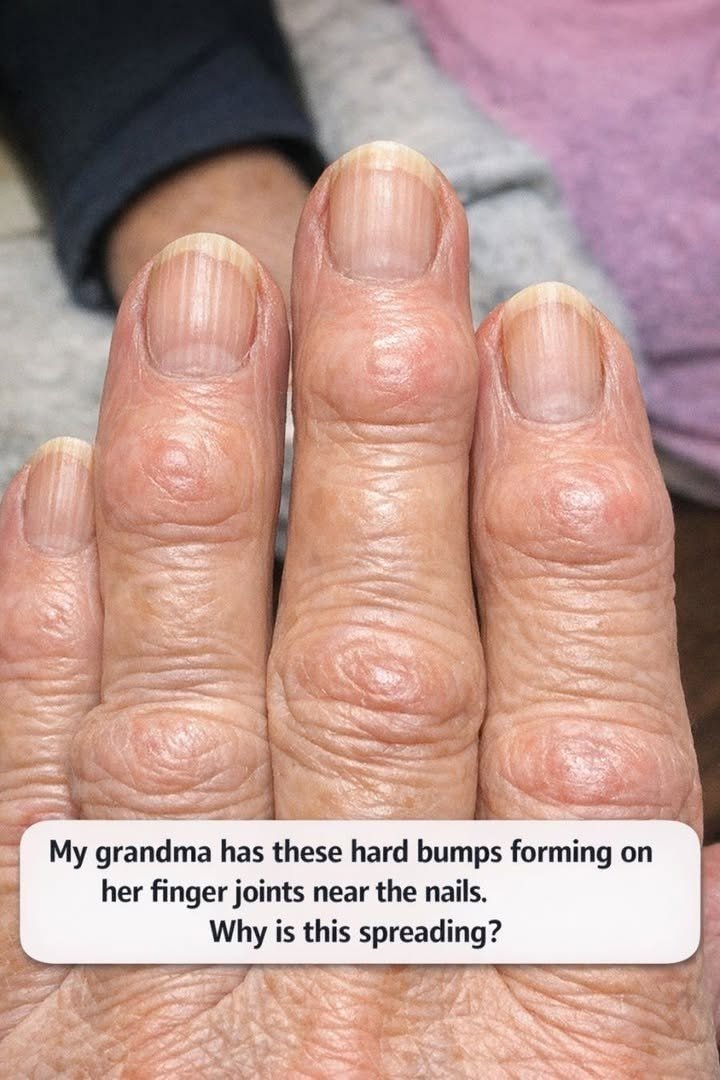
Those hard bumps forming on your grandmother’s finger joints right near the nails are very characteristic features known medically as Heberden’s nodes.
What Are They?
Heberden’s nodes are small, hard, bony enlargements that develop on the distal interphalangeal joints—the joint closest to the tip of the finger. They are a classic physical sign of osteoarthritis in the hands.
As the smooth cartilage protecting the ends of the bones gradually wears down over time, the body attempts to repair the joint by producing extra bone. These tiny bone spurs (osteophytes) are what create those hard, prominent bumps.
Why Does It Seem Like They Are “Spreading”?
It often feels like these bumps are spreading because hand osteoarthritis is a generalized, systemic joint process rather than an isolated injury. When one joint starts developing cartilage wear and bone spurs, neighboring fingers frequently undergo the same degenerative changes over time.
Additionally, hand osteoarthritis tends to be heavily influenced by genetics and family history. It often appears across multiple fingers and can affect both hands symmetrically as the natural wear-and-tear process progresses.
What to Expect and How to Manage Them
-
The Active Phase vs. Settled Phase: When these nodes are first forming, the joints can occasionally become tender, red, warm, or swollen. However, once the bone spur fully develops, the acute inflammation usually subsides, and the pain often diminishes significantly, even though the hard bump remains.
-
Comfort Measures: Gentle warmth (such as warm compresses or paraffin wax dips), hand exercises recommended by a physical or occupational therapist, and topical anti-inflammatory gels can help manage any stiffness or discomfort.
When to See a Doctor
While Heberden’s nodes are a very common part of aging and hand osteoarthritis, it is always wise to have a physician or rheumatologist evaluate them. A doctor can confirm the diagnosis, rule out other inflammatory types of arthritis (such as rheumatoid arthritis, which affects different joints), and recommend strategies to preserve hand mobility and strength.
