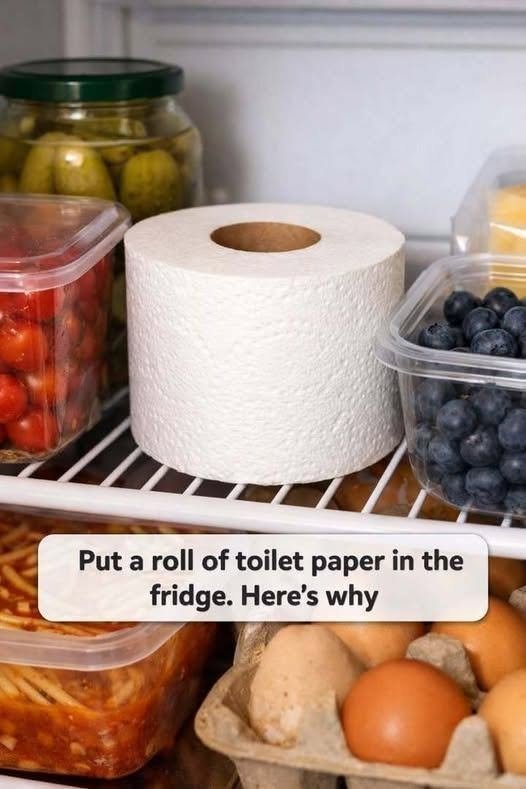
When viral home-hack headlines tell you to “put a roll of toilet paper in the fridge—here’s why,” they are recycling an old internet life-hack claiming that an ordinary roll of bathroom tissue acts as a miraculous odor absorber for stubborn refrigerator smells.
From a practical and household management perspective, the idea stems from the fact that cheap, unbleached, or standard paper pulp has porous cellulose fibers that can trap ambient moisture and some volatile organic compounds. However, looking at it through a functional kitchen lens reveals why it is more of a quirky internet curiosity than an effective solution.
The Reality Behind the Refrigerator Toilet Paper Trick
-
How the Hack is Supposed to Work: Proponents claim that because toilet paper is highly porous and designed to absorb moisture, placing a fresh roll in the fridge will pull in trapped food odors (like strong cheese, onions, or leftover garlic dishes) and absorb excess humidity that causes vegetables to spoil quickly.
-
The Scientific Catch: While paper cellulose has some mild absorptive properties, it is nowhere near as chemically efficient as activated charcoal or baking soda (sodium bicarbonate). Baking soda works through a chemical neutralization process that actively binds to and neutralizes acidic and basic odor molecules, rather than just trapping them temporarily.
-
The Hygiene and Texture Drawback: Bathrooms and refrigerators are two very different environments. Storing a porous, absorbent paper product in a cold, damp food storage space means it can easily soak up ambient food aromas, moisture, and micro-particles—making it less than ideal to move back to the bathroom later!
Better, Evidence-Based Ways to Keep Your Fridge Fresh
If your refrigerator needs a little odor management or moisture control, skip the bathroom supplies and use these tried-and-true methods instead:
-
The Classic Baking Soda Box: Place an open box of baking soda on a middle shelf. It is inexpensive, highly effective at neutralizing odors, and designed specifically for enclosed food environments. Swap it out every 3 to 4 months.
-
Activated Charcoal Deodorizers: Small, reusable activated charcoal packets or pods provide massive surface area for trapping moisture and odor molecules without taking up valuable shelf space.
-
Airlock Produce Storage: To tackle excess moisture and prevent food spoilage at the source, store leafy greens in breathable produce bags or line crisper drawers with clean paper towels (meant for the kitchen!) to absorb condensation.
Are you looking into clever kitchen organization shortcuts, or exploring practical tips for everyday home maintenance?
