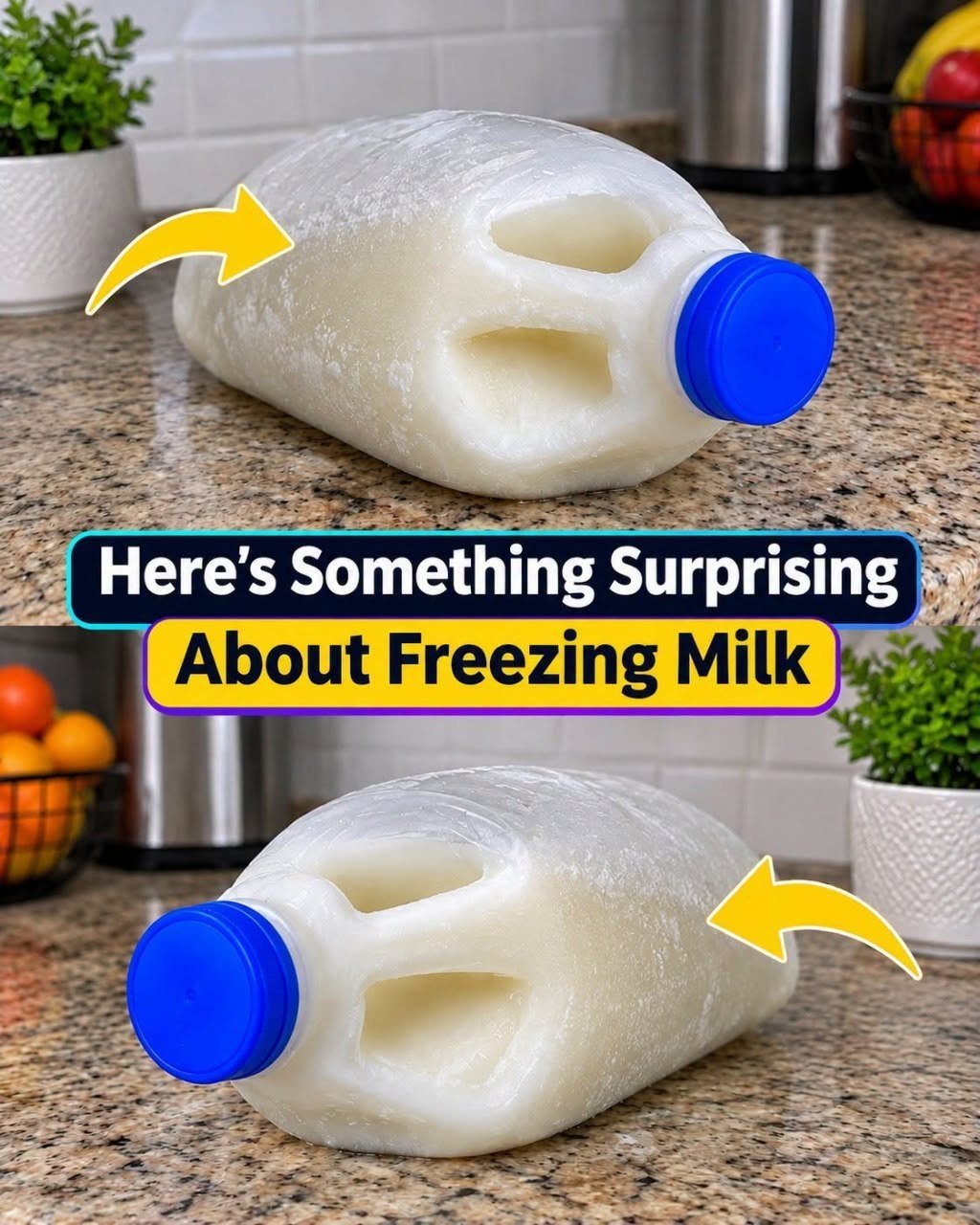
Freezing milk is a practical way to extend its shelf life by up to 3 months, but low temperatures alter its physical structure and functional properties.
What Happens When You Freeze Milk
1. Fat and Water Separation
-
Mechanism: Milk is an emulsion of fat droplets suspended in water. When milk freezes, water forms ice crystals first, pushing fat and protein molecules into dense pockets.
-
Impact: Thawed milk often separates, taking on a grainy, watery, or yellow-tinted appearance. Higher-fat milks (whole or half-and-half) separate significantly more than skim or 1% milk.
2. Expansion of Liquid
-
Mechanism: Water expands by roughly $9\%$ as it crystallizes into ice.
-
Impact: Freezing milk in a completely full, sealed glass or original plastic container can crack glass jars or pop the caps off plastic jugs.
3. Preservation of Nutrients and Safety
-
Mechanism: Sub-zero temperatures ($0^\circ\text{F}$ or $-18^\circ\text{C}$) stop bacterial growth completely without destroying proteins, calcium, or essential vitamins.
-
Impact: Expands raw freshness safely, though subtle flavor shifts may occur over time.
Correct Protocol for Freezing & Thawing Milk
Best Uses by Milk Type
| Milk Variant | Freeze Quality | Primary Post-Thaw Use |
| Skim / 1% Milk | Excellent: Minimal fat separation | Drinking, cereal, baking, and cooking |
| Whole Milk | Good: Mild fat separation; requires shaking | Baking, soups, sauces, and smoothies |
| Heavy Cream / Half-and-Half | Fair: High separation; loses whip capability | Cooking, baking, and hot soups (not for whipping) |
| Plant Milks (Almond, Soy, Oat) | Poor: High separation and watery texture | Baking and smoothie bases only |
