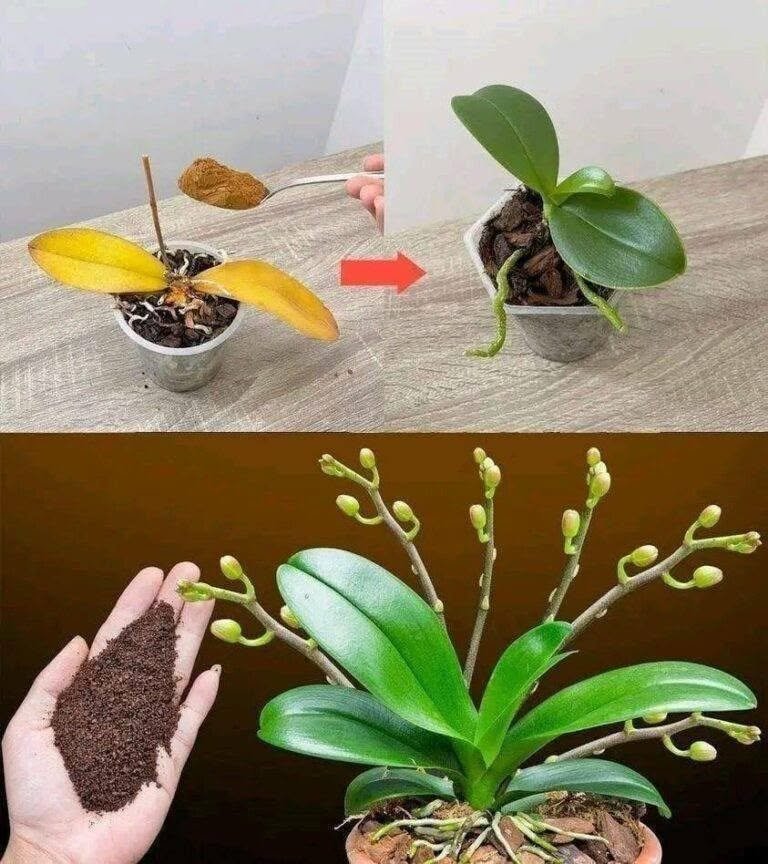
That popular internet clickbait trick—promising that “just a teaspoon” of a mystery household kitchen ingredient (like sugar, cinnamon, garlic water, rice water, or baking soda) will make an orchid magically erupt into bloom—is mostly a myth, and in some cases, can actually kill your orchid.
Orchids do not bloom from quick-fix kitchen tricks. Instead, they require specific environmental signals and proper basic care.
Why Kitchen “Teaspoon” Hacks Fail
-
Sugar or Rice Water: Pouring sugar or starch onto orchid roots feeds harmful bacteria and fungi in the damp potting medium, causing root rot—the number one killer of indoor orchids.
-
Cinnamon: While cinnamon is a great natural antiseptic for cut leaves or roots, applying it to healthy roots acts as a desiccant, drying them out completely.
-
Baking Soda / Vinegar: Drastically alters the pH of the bark medium, scorching the delicate aerial roots.
The Real “Secret” to Making Orchids Bloom
If your orchid has healthy green leaves but hasn’t bloomed in over a year, you don’t need a magic teaspoon. You just need to trigger its natural flowering cycle:
1. The 10–15°F Nighttime Temperature Drop (The True Trigger)
Most common orchids (Phalaenopsis) need a cool temperature drop at night for 2 to 4 weeks to induce a flower spike.
-
How to do it: Move your orchid to a cooler room or near a window (out of direct frost) where night temperatures fall to around 55°F–65°F (13°C–18°C) while day temperatures stay around 70°F–75°F. Within a month, you should see a green flower spike emerging between the lower leaves.
2. Bright, Indirect Light
If an orchid’s leaves are dark, forest green, it isn’t getting enough light. Leaves should be a bright lime-green color. Place it near an east-facing window or just out of direct sun near a south/west window.
3. Balanced Orchid Fertilizer (Applied Weakly)
Instead of kitchen ingredients, use a balanced orchid fertilizer (such as a 20-20-20 or 10-10-10 formula):
-
Dosage: Dissolve ¼ to ½ teaspoon of real orchid fertilizer per gallon of water.
-
Schedule: Apply “weakly, weekly” during periods of active leaf and root growth, but stop fertilizing once the plant is in full bloom.
Quick Health Check
| Leaf / Root Condition | What It Means | Action Needed |
| Dark Forest Green Leaves | Too little light | Move to a brighter location |
| Yellowish / Scorched Leaves | Too much direct sun | Move away from intense rays |
| Plump, Firm Green/Silver Roots | Healthy root system | Maintain current watering routine |
| Mushy, Brown, or Black Roots | Overwatered / Root rot | Repot in fresh bark, cut dead roots |
