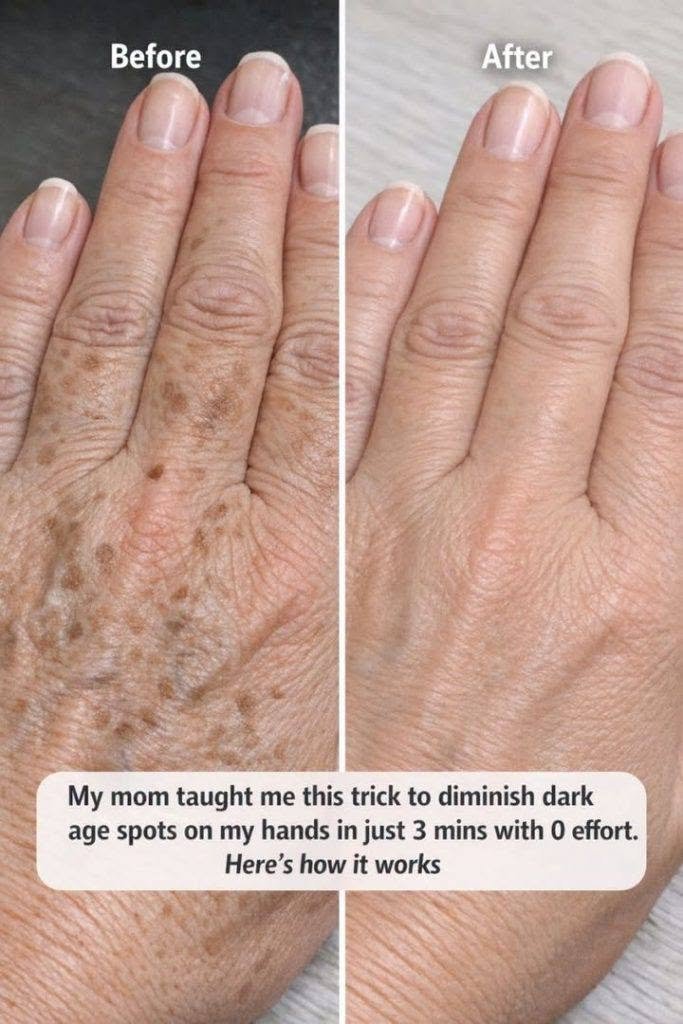
Viral beauty hooks promising to erase dark age spots (solar lentigines) in “just 3 minutes with zero effort” usually refer to old-school kitchen remedies—like dabbing lemon juice, apple cider vinegar, or baking soda paste onto the skin.
While home remedies are tempting, dermatologists urge caution when it comes to quick fixes for hyperpigmentation. Here is the medical reality behind how age spots form, what DIY tricks actually do, and how to safely minimize them.
What Are Age Spots, Really?
Age spots are not caused by aging alone; they are the cumulative result of years of ultraviolet (UV) sun exposure. When UV rays hit your skin, melanocytes (pigment-producing cells) go into overdrive, clustering together to produce excess melanin as a defense mechanism.
Because our hands are constantly exposed to the sun while driving, walking, and gardening without daily sunscreen, they are prime real estate for age spots.
Why “3-Minute Kitchen Tricks” Can Be Risky
-
The Lemon Juice Myth: People often apply raw lemon juice to spots, hoping the natural acid will bleach the pigment. While citrus contains vitamin C, raw lemon juice is highly acidic and phototoxic. If you step into the sun with lemon juice on your skin, it can cause a severe chemical reaction called phytophotodermatitis, leading to painful blisters and darker pigmentation.
-
Scrubbing and Irritation: Harsh physical scrubs or baking soda pastes can strip the skin barrier, causing inflammation. For sensitive skin on the hands, inflammation actually triggers more melanin production, making dark spots worse over time.
How to Actually Fade Age Spots (The Dermatologist Way)
If you want real, safe, and gradual results, dermatologists recommend evidence-based ingredients and habits:
-
Daily Broad-Spectrum Sunscreen (SPF 30+): This is the single most important step. Without sunscreen, any treatment you use will instantly be undone the moment your hands see daylight.
-
Topical Brighteners: Look for hand creams or serums containing proven pigment-fading ingredients like vitamin C, niacinamide, alpha arbutin, or gentle retinoids. These inhibit melanin production and gently speed up cell turnover.
-
Exfoliation with Care: Using a gentle chemical exfoliant (like glycolic or lactic acid) once or twice a week helps slough off dead, pigmented surface cells safely.
-
Professional Treatments: For stubborn spots, dermatologists can use quick in-office treatments like cryotherapy (freezing), chemical peels, or intense pulsed light (IPL) lasers, which dramatically fade age spots in just a few sessions.
The Takeaway: While a 3-minute kitchen hack sounds like a dream, real skincare takes a little more patience. Protecting your hands with daily SPF and using a brightening cream will yield much safer, lasting results!
Would you like some recommendations for over-the-counter ingredients or gentle hand care routines to help fade age spots safely?
