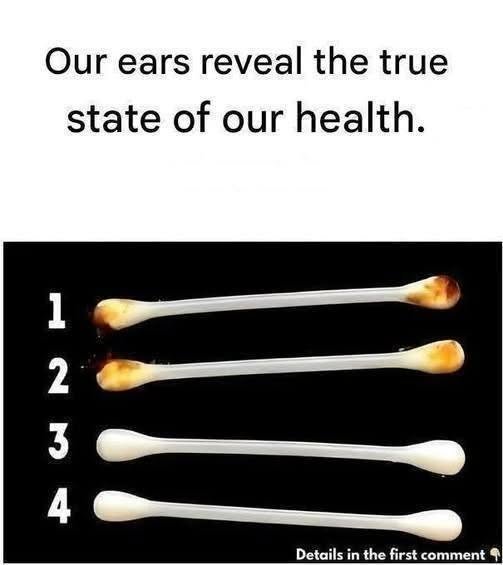
Viral online posts and alternative health guides often claim that “Our ears reveal the true state of our health,” promoting ideas like auricular reflexology—the notion that pressing specific points on the outer ear can diagnose or heal internal organ diseases—or suggesting that ear shape determines lifespan.
In clinical otolaryngology, neurology, and cardiology, the ears do not serve as a holistic diagnostic map for every internal organ. However, because the outer, middle, and inner ear are rich in blood vessels, nerves, and cartilage, subtle visual and sensory changes in the ears can provide genuine clinical clues about your cardiovascular, metabolic, and systemic health.
Here is an objective, science-based breakdown of what your ears can (and cannot) reveal about your health:
Valid Medical Indicators Seen in the Ears
1. Frank’s Sign (Diagonal Earlobe Crease)
-
What It Is: A clear, diagonal crease running across the earlobe from the tragus to the outer edge.
-
The Clinical Significance: Multiple epidemiological studies have documented an association between Frank’s Sign and an increased risk of Coronary Artery Disease (CAD) and peripheral vascular disease.
-
The Mechanism: The earlobe is supplied by end-arteries with no collateral circulation. A loss of elastic fibers and degradation of tiny blood vessels in the earlobe—which creates the crease—often mirrors similar vascular loss and loss of elasticity occurring simultaneously in the coronary arteries.
2. Pulsatile Tinnitus (Rhythmic Whooshing in the Ear)
-
What It Is: Hearing a rhythmic thumping, whooshing, or beating sound in one or both ears that syncs with your heartbeat.
-
The Clinical Significance: Unlike standard tinnitus (ringing caused by inner ear hair cell damage), pulsatile tinnitus is usually a structural or vascular phenomenon.
-
The Mechanism: It often signals altered blood flow near the ear structures, which can be caused by idiopathic intracranial hypertension (high pressure around the brain), high blood pressure, carotid artery stenosis, or vascular malformations (like glomus tumors or arteriovenous fistulas).
3. Gouty Tophi (Hard Nodules on the Outer Ear)
-
What It Is: Small, firm, painless or tender white-to-yellowish bumps on the cartilage of the outer ear (the helix or antihelix).
-
The Clinical Significance: A classic sign of advanced or chronic gout.
-
The Mechanism: When serum uric acid levels remain high for extended periods, needle-like monosodium urate crystals deposit in cool peripheral tissues with low blood supply—such as ear cartilage—forming physical nodular deposits called tophi.
4. Red Ear Syndrome and Flushing
-
What It Is: Episodic, intense burning pain and redness in one or both earlobes and cartilage.
-
The Clinical Significance: Associated with migraines, trigeminal neuralgia, or erythromelalgia.
-
The Mechanism: Disruption or hyperactivity of the cervical spinal nerves or trigeminal nerve pathways causes localized vasodilation and sharp cutaneous discomfort.
5. Sudden Sensorineural Hearing Loss or Unilateral Ringing
-
What It Is: A sudden drop in hearing or new-onset ringing in only one ear over a few hours or days.
-
The Clinical Significance: Requires urgent otolaryngological evaluation.
-
The Mechanism: Can stem from viral infections of the auditory nerve, microvascular blockages (a tiny clot affecting the internal auditory artery), or, less commonly, an acoustic neuroma (a benign tumor on the vestibular nerve).
What the Ears CANNOT Reveal (Debunking Myths)
-
Auricular Reflexology Cures: The claim that pressing a specific micro-point on the earlobe can cure liver cirrhosis, kidney failure, or reverse diabetes is scientifically invalid. The outer ear is innervated by cranial nerves (like the vagus nerve), so gentle massage can induce relaxation or lower stress markers, but it cannot repair organic organ pathology.
-
Earwax Color as an Internal Detox Metric: While changes in earwax texture can occasionally reflect localized skin conditions or fungal buildup, earwax does not reflect the “toxic load” of your liver or kidneys.
The Medical Takeaway
While your ears are not a magic diagnostic sphere for every organ, they are sensitive vascular and neurological checkpoints. If you notice a sudden diagonal earlobe crease paired with cardiovascular risk factors, experience pulsatile whooshing that matches your pulse, or develop sudden unilateral hearing changes, consult a physician or ENT specialist for a formal evaluation.
