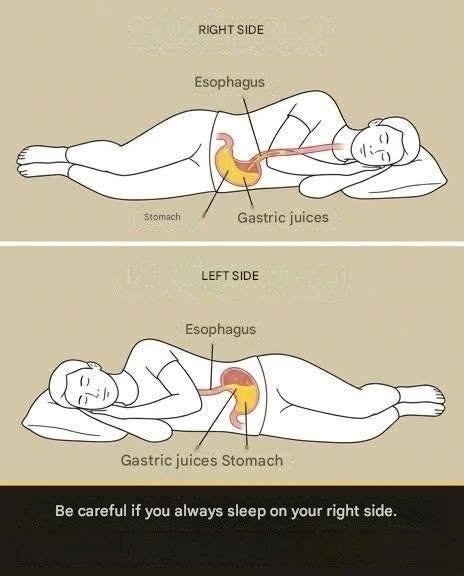
When you sleep exclusively on your right side, your physiological well-being is directly influenced by how gravity interacts with your internal anatomy, particularly your digestive and circulatory systems. Because the human stomach is asymmetrically positioned on the left side of the abdominal cavity and curves toward the right, lying permanently on your right side places the gastric junction—the muscular valve connecting your esophagus to your stomach—in a vulnerable position relative to stomach acid.
If you maintain this habit night after night, your body experiences several distinct consequences:
-
Elevated Risk of Chronic Acid Reflux: When you rest on your right side, the fluid level of gastric acid sits higher than the lower esophageal sphincter, allowing gravity to easily push acid upward into the delicate lining of the esophagus. Over time, this frequent exposure can lead to persistent heartburn, irritation, and symptoms of gastroesophageal reflux disease (GERD).
-
Increased Asymmetrical Strain on Spinal and Pelvic Alignment: Without proper ergonomic support, exclusive right-side sleeping causes your upper leg to rotate downward and pull across your body. This subtle torsion misaligns your lumbar spine, pelvis, and hips, potentially leading to chronic lower back stiffness or morning hip discomfort.
-
Localized Dermal Compression: Continuous nighttime pressure against the right side of your face accelerates mechanical friction on your skin, which can contribute to asymmetric sleep wrinkles and creases over years of repetition.
To counteract these effects while maintaining your preferred posture, sleep specialists recommend placing a firm pillow between your knees to keep your hips neutrally stacked, and considering a transition to your left side if you suffer from nighttime digestive flare-ups.
