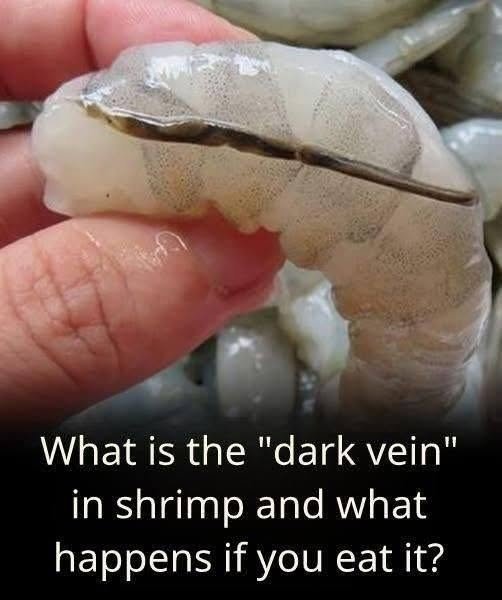
The dark thread running along the back of a shrimp is not actually a blood vessel—it is the animal’s gastrointestinal tract (digestive tract).
While consuming it is generally non-toxic, removing it—a process known as deveining—is widely practiced for reasons of texture, food hygiene, and visual presentation.
Biological Composition & Culinary Impact
-
Content: The tract contains partially digested food matter, sand, grit, and mud ingested by the shrimp while bottom-feeding.
-
Texture & Flavor: Leaving the vein intact can introduce an unpleasant gritty texture and a muddy, bitter off-flavor to delicate seafood dishes.
-
Microbial Load: Because it is the digestive tract, it carries higher bacteria levels than the muscle tissue. While thorough cooking ($145^\circ\text{F}$ / $63^\circ\text{C}$) kills active pathogens, removing it reduces total microbial load.
-
Size Variability: Large shrimp (such as jumbo or tiger shrimp) have pronounced, thick digestive tracts that are unappealing to eat. In tiny salad shrimp, the tract is minimal and rarely needs removal.
Deveining Necessity Matrix
| Shrimp Size | Vein Visibility | Deveining Recommendation | Primary Reason |
| Colossal / Jumbo ($<20\text{ per lb}$) | Very dark and thick | Mandatory | High grit content and strong bitter flavor |
| Medium ($31\text{–}50\text{ per lb}$) | Moderately visible | Recommended | Texture preservation and visual appeal |
| Small / Salad ($>60\text{ per lb}$) | Fine or invisible | Optional | Minimal grit impact; labor-intensive to remove |
