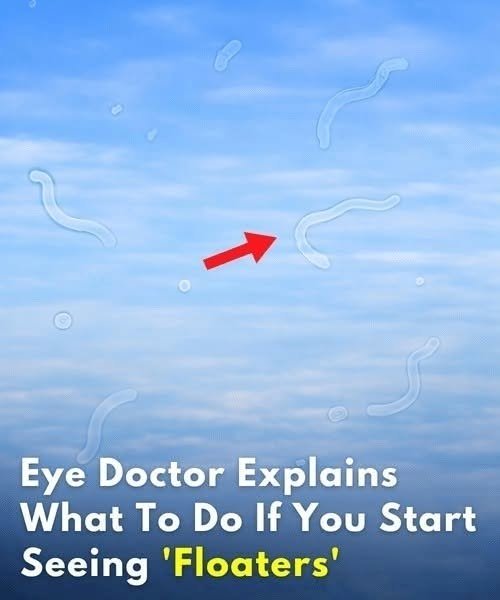
When health and wellness articles offer an eye doctor’s guide on what to do if you start seeing eye floaters, they are addressing a very common visual phenomenon. Floaters—those tiny specks, threads, cobwebs, or spots that drift across your field of vision—can be both annoying and alarming when they appear suddenly.
Let’s cut through the worry, examine what floaters actually are from an optometric and ophthalmological perspective, and look at when they require immediate medical attention versus when they are a normal part of aging.
What Are Eye Floaters? (The Biological Reality)
Eye floaters are not actually outside your eye; they are tiny clumps of gel or cellular debris floating inside the vitreous humor—the clear, jelly-like substance that fills the inside of your eyeball.
As light passes through the vitreous, these tiny clumps cast shadows onto your retina (the light-sensitive tissue at the back of your eye), which you perceive as floating spots or threads.
The Primary Cause: Posterior Vitreous Detachment (PVD)
-
The Clinical Reality: As we age (most commonly after age 50 or 60), the gel-like vitreous humor naturally liquefies and shrinks, eventually pulling away from the retina. This process is called a Posterior Vitreous Detachment (PVD).
-
The Result: When the vitreous pulls away, it often creates a sudden shower of new floaters or wispy cobwebs. While PVD itself is a normal, non-blinding part of aging, it requires a professional eye examination to ensure it didn’t cause any retinal damage.
Red Flag Symptoms: When Floaters Indicate Danger
While most floaters are harmless age-related annoyances, a sudden onset can occasionally signal a severe, sight-threatening emergency: Retinal Detachment.
When the shrinking vitreous pulls away, it can tug so hard on the retina that it tears or detaches. If you experience any of the following “red flag” symptoms alongside new floaters, seek immediate emergency eye care or go to an emergency room:
-
A Sudden Shower of New Floaters: Going from a few mild spots to dozens of sudden dark specks or a hazy cloud overnight.
-
Flashings of Light (Photopsia): Seeing sudden, brief flashes of light (like camera lightning or lightning streaks in your peripheral vision), caused by the vitreous pulling on the retina.
-
A “Curtain” or “Shadow” in Your Vision: A dark curtain, shadow, or gray veil moving across any part of your peripheral or central field of view. This is a classic sign of an active retinal detachment.
What to Do If You Notice New Floaters
-
Get a Dilated Eye Exam Promptly: If you notice a sudden onset of new floaters—especially if accompanied by flashes—schedule an urgent dilated eye examination with an optometrist or ophthalmologist within 24 to 48 hours. An eye doctor must use specialized lenses to look at the periphery of your retina to ensure no tears have occurred.
-
Do Not Ignore Persistent Changes: Even if there are no flashes or shadows, any sudden change in your vision warrants a professional checkup to rule out retinal tears or inflammation inside the eye (uveitis).
-
Learn to Adapt (For Benign Floaters): If your doctor examines your eyes and confirms the floaters are harmless, age-related debris, the best approach is often psychological adaptation. Over time, your brain naturally learns to “ignore” or filter out static floaters as they drift out of your central line of sight.
