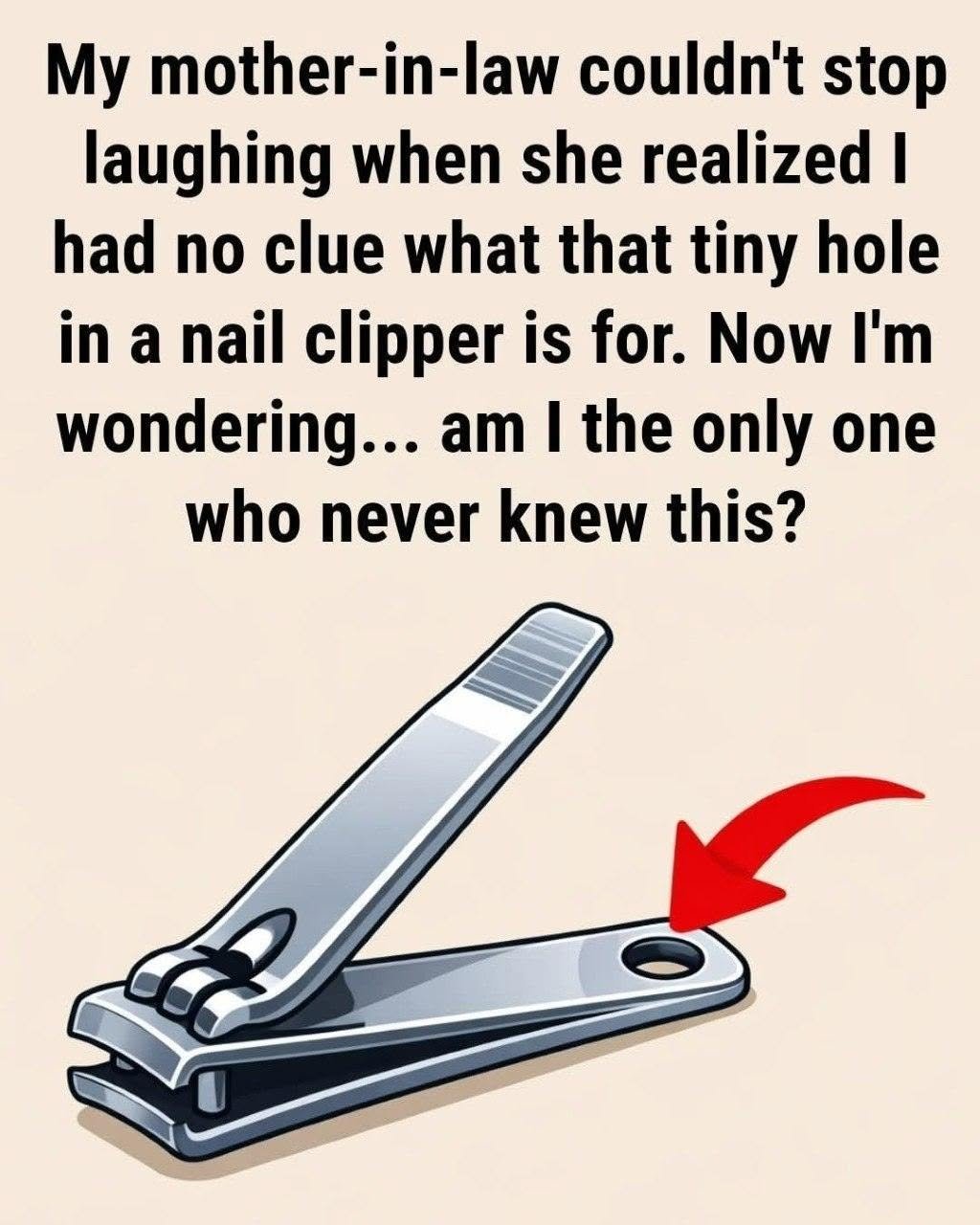
When curiosity-driven life-hack articles ask, “What’s the small round hole on your nail clipper for?” they often frame it as a secret engineering marvel that most people have been using wrong their entire lives—sometimes spinning elaborate myths about hanging up your clippers or threading special wires.
The reality is much simpler, rooted entirely in how these small tools are manufactured.
The Real Reason for the Hole
That tiny circular hole at the end of the lever on standard lever-style nail clippers is a manufacturing byproduct of the stamping and assembly process, rather than a functional feature designed for everyday users.
-
Punching and Riveting: Nail clippers are stamped out of sheets of spring steel. The metal lever, the base, and the cutting jaw are held together by a central metal pin (a rivet). During high-speed factory assembly, machines often use punched alignment holes or hanging loops to hold, position, or rivet the components together as they move down the production line.
-
Material Reduction: Punching a small hole also slightly reduces the weight and metal volume of the lever without compromising its structural strength when you press down.
What Internet Myths Claim It Is For
Viral life-hack videos love to assign magical, alternative purposes to this little hole:
-
The “Keychain Loop” Theory: While you can thread a thin keyring or lanyard through the hole to attach the clipper to your keys, that is usually an accidental convenience rather than the primary design intent.
-
The “Wire Stripper” Fallacy: Some hacks claim it is engineered to strip electrical wires. Trying to wedge a copper wire into that tiny, unsharpened aperture will usually just bend your clipper lever or ruin the tool.
The Bottom Line
The small round hole on your nail clipper is simply a manufacturing artifact from how the metal parts are stamped, aligned, and pinned together in the factory. While it makes a handy spot for a keyring, it is not a secret tool feature waiting to be unlocked.
