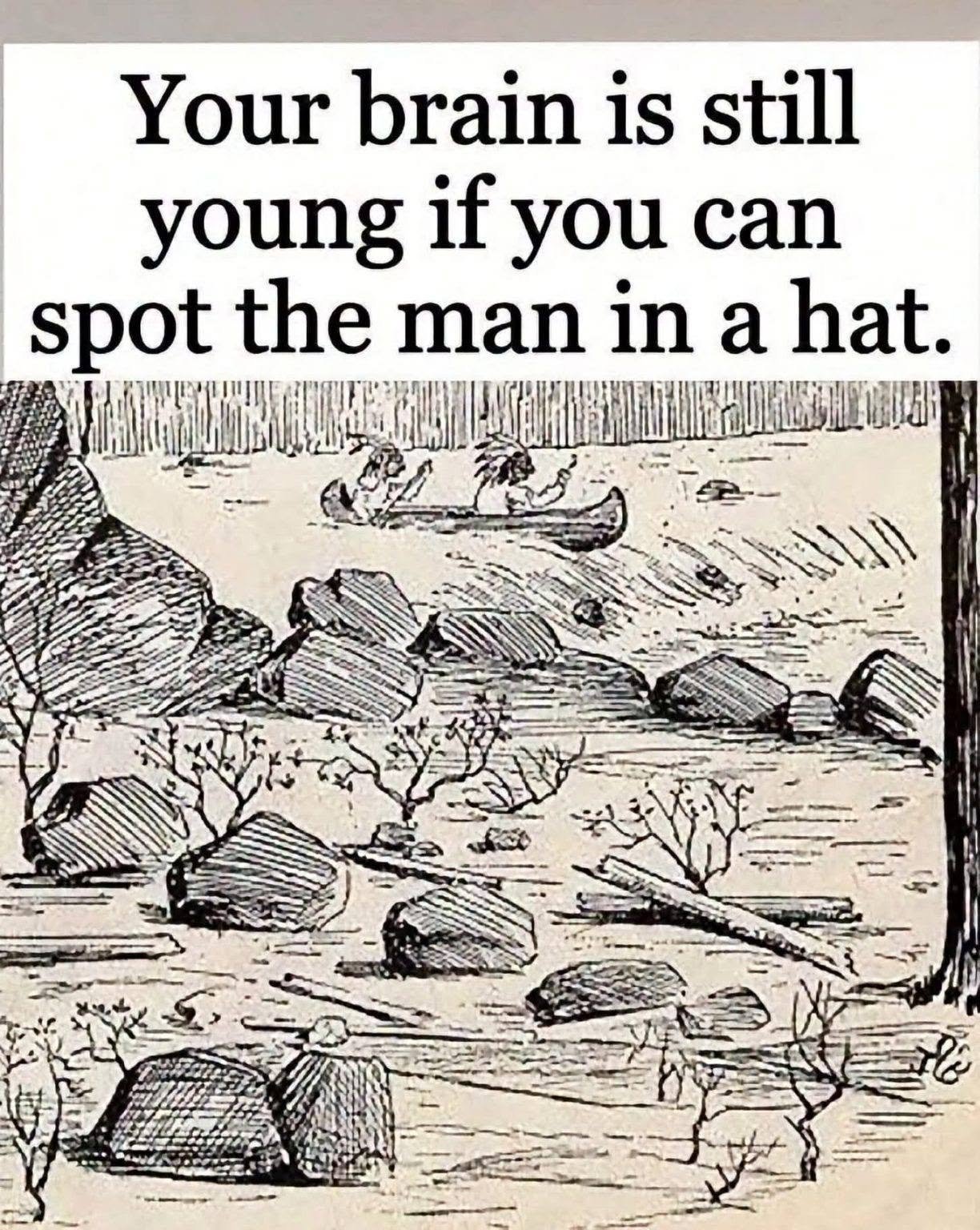
The phrase “Your brain is still young if you can spot the man in a hat” is a popular hook often attached to vintage optical illusions and hidden-figure puzzles.
While it makes for a fun and engaging internet challenge, it has no actual basis in science or neurology. Spotting the hidden face quickly doesn’t mean your brain is young, and struggling to find it is not a sign of cognitive decline.
Here is what is actually happening when you look at these types of puzzles:
1. Gestalt Psychology and Visual Hierarchies
The human brain naturally tries to make sense of complex visual information by categorizing objects into a foreground and a background (known in psychology as Gestalt principles). In a landscape illusion, your brain immediately recognizes trees, rocks, water, or sky as the primary objects. Because the landscape is so prominent, it acts as a camouflage, masking the secondary shapes (the man’s face or hat) that are cleverly formed by the negative space and shadows.
2. Why Some People Spot It Faster Than Others
How quickly you solve a hidden-image puzzle depends on a variety of temporary, situational factors rather than biological age:
-
Viewing Distance and Screen Size: Looking at a small phone screen versus a large monitor completely changes how your visual cortex processes fine lines and broad shapes. Moving further back from the screen often helps your eyes shift from micro-details to the macro-image.
-
Visual Search Strategy: People who instinctively scan for broad contours, horizontal lines (like a hat brim), or negative space will find the hidden image faster than someone hyper-focused on individual details like rocks or leaves.
-
Prior Experience: If you have spent time looking at similar optical illusions, your brain knows how to deconstruct the image faster.
Tips for Finding the Hidden Man
If you are staring at one of these puzzles and can’t find the figure:
-
Squint or step back: Blurring your vision slightly reduces distracting textures and forces your brain to look at the overall composition.
-
Hunt for the hat first: Look for a distinct curved or horizontal shape (the brim or crown) near the top or middle regions rather than searching for a face right away. Once you anchor onto the hat, the facial features formed by the surrounding shadows usually snap into view.
