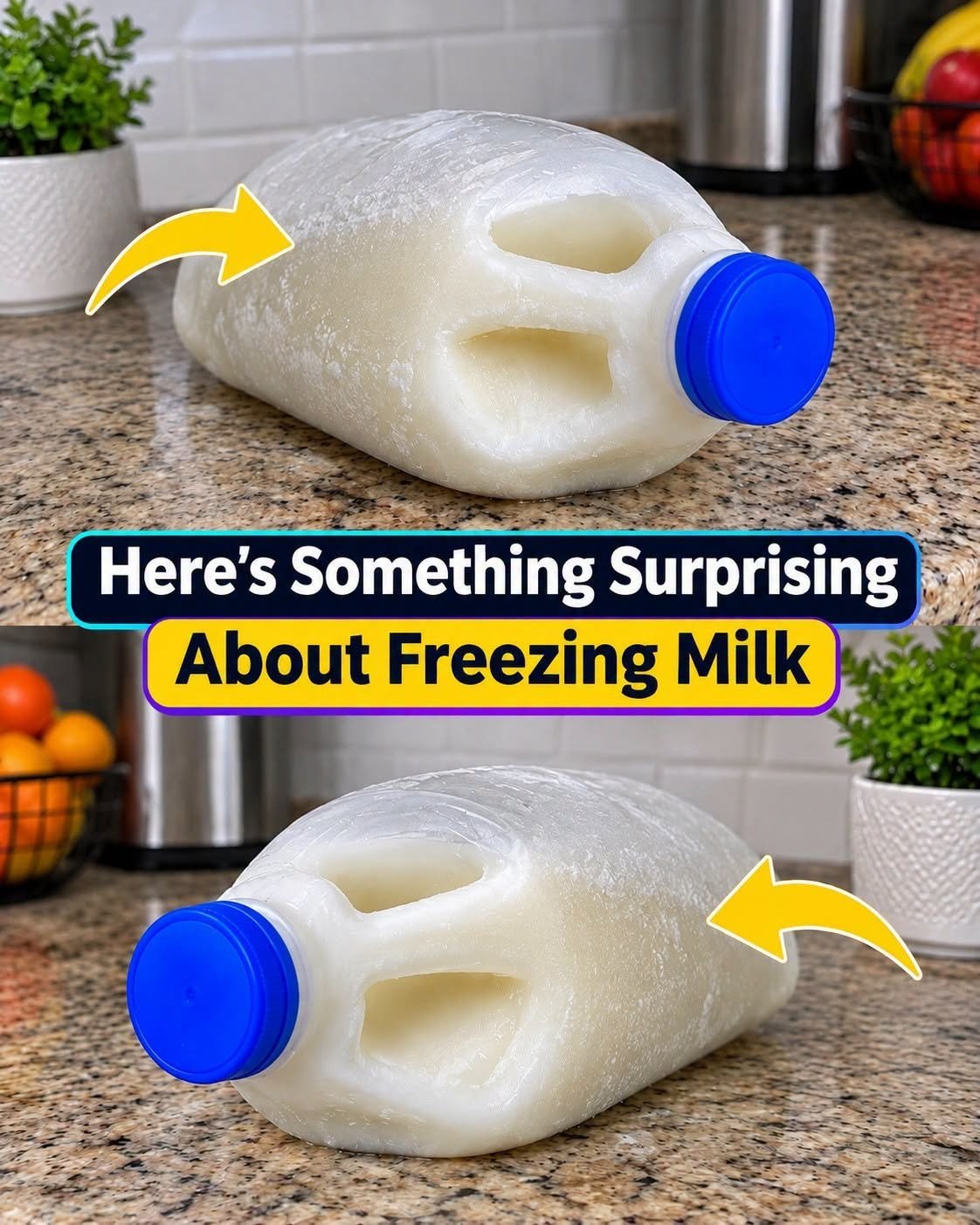
When household and kitchen clickbait flashes headlines like “I Never Knew Freezing Milk Could…,” they love to rely on a breathless teaser designed to make you panic about basic food preservation. They want you to believe that storing a gallon of dairy in your freezer will trigger a catastrophic chemical reaction, explode your containers, or turn your morning cereal into a toxic hazard.
From a food science, dairy chemistry, and practical home-management perspective, freezing milk is entirely safe and remarkably straightforward. While physics and dairy emulsions do undergo a few predictable shifts when frozen, understanding the science cuts straight through the clickbait.
The Science Behind Freezing Milk
What actually happens to milk when temperatures drop below freezing (32°F / 0°C)?
-
Expansion and Container Pressure: Water expands as it freezes. If you freeze milk in a rigid, tightly sealed glass bottle or a completely full plastic jug, the expanding liquid can crack the glass or burst the seams. Leaving adequate headspace in a freezer-safe container solves this completely.
-
Phase Separation (Emulsion Breakdown): Milk is a natural emulsion—an intricate suspension of water, fats, proteins (casein), and lactose. When frozen and subsequently thawed, the fat globules tend to clump together, resulting in a slightly watery or grainy texture.
-
Nutritional Integrity Remains Intact: Freezing does not degrade milk’s core nutritional value. Its protein, calcium, and vitamin content remain virtually unchanged during cold storage, provided it is kept at or below 0°F (-18°C).
The Reality of Thawed Milk (And How to Handle It)
When you thaw frozen milk, here is what you will actually notice in practice:
-
Separation and Graininess: Because the emulsion breaks down slightly, thawed milk may look a bit watery or separated. The solution: A vigorous shake or a quick whirl in a blender restores a smooth, uniform consistency.
-
Best Uses After Thawing: While thawed milk is perfectly safe to drink on its own, its slightly altered texture makes it ideal for cooking, baking, smoothies, or morning oatmeal where the minor physical separation is completely unnoticeable.
-
Storage Limits: For optimal taste and quality, use frozen milk within 1 to 3 months. Beyond that, it remains safe to consume indefinitely if kept solidly frozen, but flavor absorption from other freezer items can occur.
