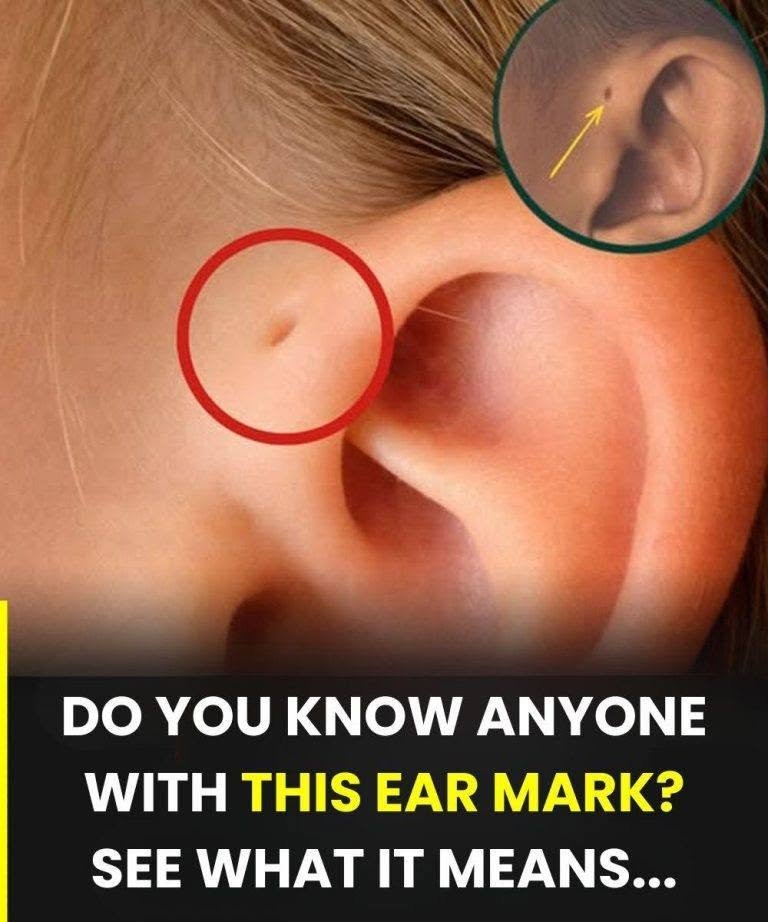
The distinct diagonal fold or line running across the earlobe is known in medicine as Frank’s sign (named after Dr. Sanders T. Frank, who first described it in 1973).
It typically appears as a deep, distinct crease extending at roughly a 45-degree angle from the tragus (the small projection in front of the ear canal) down to the outer edge of the earlobe.
What It Means
For decades, clinical researchers have studied Frank’s sign because observational studies have noted a statistical correlation between this earlobe crease and an increased risk of cardiovascular disease and coronary artery narrowing.
While researchers are still exploring the exact underlying mechanism, the leading theories point to systemic changes in microvascular health and elastic fibers:
-
Shared Structural Changes: The earlobe is supplied by tiny terminal blood vessels. As people age, microvascular damage, loss of elastic tissue, and stiffening can affect these small vessels.
-
The Cardiovascular Connection: Because similar degenerative and atherosclerotic processes affect larger arteries throughout the body, a prominent crease has occasionally been viewed as a visible external clue to vascular aging.
Putting It in Perspective
Despite its fascinating history in medical literature, Frank’s sign is not a diagnostic tool on its own.
-
Age and Normal Variation: Earlobe creases become much more common naturally as people age, and many older adults have them entirely unrelated to heart disease. Conversely, many people with cardiovascular disease do not have Frank’s sign.
-
A Prompt for Wellness: Rather than a cause for alarm, medical professionals view it merely as a point of curiosity—a prompt to ensure that established, high-impact cardiovascular risk factors (such as blood pressure, cholesterol levels, blood sugar, and lifestyle habits) are actively managed.
