When sensationalized health headlines or viral advertisements proclaim, “New method: colonoscopy will no longer be an invasive examination,” they rely on conflating non-invasive screening options with actual diagnostic and therapeutic procedures.
While medical technology has introduced powerful non-invasive ways to screen for colorectal cancer, treating them as a complete, drop-in replacement for traditional colonoscopy misrepresents how these tools actually function in clinical practice.
What Clickbait “Non-Invasive Colonoscopy” Claims Get Wrong
-
The “Total Replacement” Fallacy: Clickbait articles often frame new screening tests as a magical substitute that makes optical colonoscopy entirely obsolete, ignoring the distinct clinical roles each test plays.
-
Ignoring the Follow-Up Reality: Sensationalized headlines gloss over the crucial fact that if a non-invasive screening test detects an abnormality, a traditional colonoscopy is still required to investigate and resolve it.
The Clinical Reality: Screening vs. Diagnostic Procedures
Gastroenterologists and oncologists separate colorectal care into two distinct categories: screening (checking average-risk individuals for signs of disease) and diagnosis/treatment (investigating symptoms or removing physical growths).
While non-invasive options have expanded accessibility for average-risk screening, they operate via entirely different mechanisms:
-
Stool and Blood Biomarker Tests (e.g., FIT, Cologuard, Liquid Biopsies): These tests analyze stool samples or circulating blood for hidden traces of blood or aberrant DNA/RNA markers. They are convenient, non-invasive ways to flag potential risks from home, but they cannot visualize the colon directly or remove tissue. A positive result on any non-invasive test always requires a follow-up traditional colonoscopy.
-
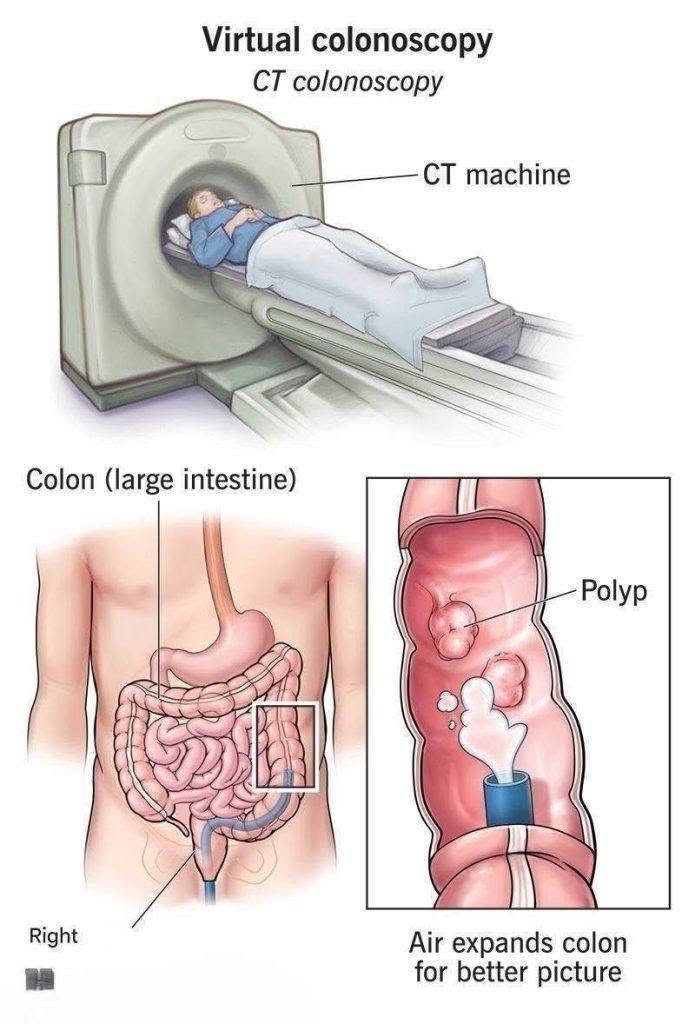
Virtual Colonoscopy (CT Colonography): This imaging technique uses advanced computed tomography (CT) to generate 3D views of the large intestine without sedation. While it avoids a physical scope, it still requires strict bowel preparation (laxatives and enemas) and air inflation. Furthermore, if the radiologist spots a polyp or suspicious lesion during the scan, the patient must still undergo a traditional colonoscopy to have it removed.
Why Traditional Colonoscopy Remains the Gold Standard
A traditional colonoscopy remains unique because it is both diagnostic and therapeutic in a single session. While passing a thin, flexible scope allows a physician to directly visualize the entire mucosal lining of the colon, it also allows them to immediately take precise tissue biopsies and completely remove precancerous polyps before they have a chance to develop into cancer. No stool test, blood test, or virtual scan can physically remove a polyp.
The Bottom Line
Non-invasive screening methods are fantastic tools that help increase overall screening compliance for average-risk individuals, but they do not eliminate the need for traditional colonoscopies. Skip the overhyped clickbait, and talk to your healthcare provider about which screening pathway best aligns with your age, family history, and personal risk profile.
