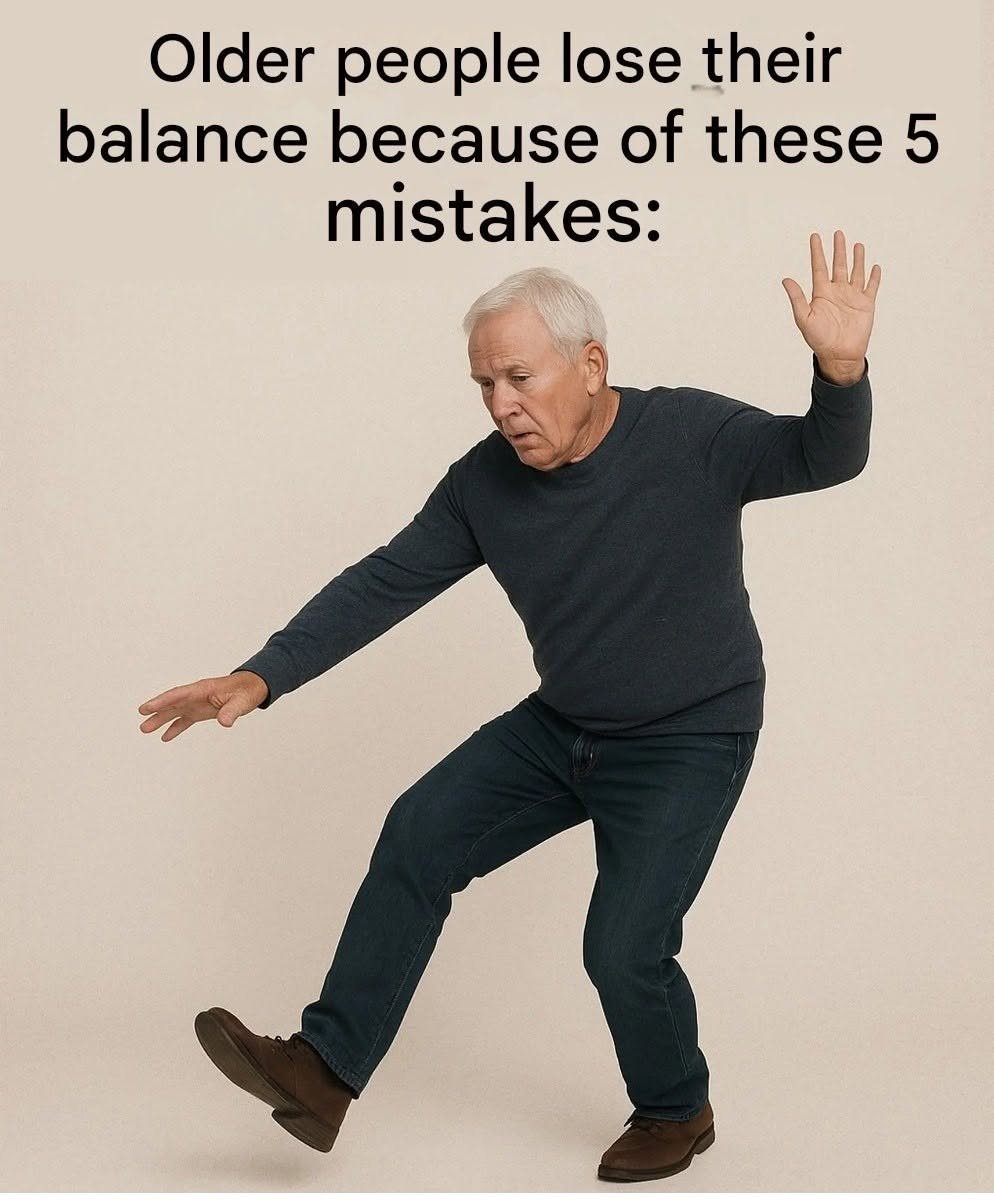
Maintaining robust balance as we age is a complex neurological and physical symphony involving your inner ear (vestibular system), vision, proprioception (joint position awareness), and core musculature. When clickbait health guides discuss balance, they often focus solely on the end result—a fall—while ignoring the subtle, everyday habits that slowly erode stability over time.
Examining the clinical reality of age-related balance changes reveals five common, correctable mistakes that undermine stability in older adults.
1. Neglecting Lower-Body Strength Training
-
The Mistake: Believing that casual walking is enough to maintain lower-body fitness. While walking is wonderful for cardiovascular health, it does not build the explosive lower-leg and hip strength required to catch yourself if you trip.
-
The Correction: Focus on functional strength exercises—such as sit-to-stands (rising from a chair without using your hands) and heel-to-toe walking—to strengthen the quadriceps, glutes, and calves.
2. Wearing Unsupportive or Improper Footwear Indoors
-
The Mistake: Walking around the house in slick-soled slippers, loose socks, or barefoot. Slippers without traction or walking in socks on hardwood and tile floors dramatically increase the risk of sliding or catching a toe.
-
The Correction: Wear supportive shoes or slip-resistant indoor footwear with rubber soles even when at home.
3. Ignoring Vision and Hearing Changes
-
The Mistake: Waiting years between eye exams or dismissing mild hearing loss as a mere annoyance.
-
The Clinical Connection: Your inner ear houses both your hearing apparatus and your vestibular balance center. Furthermore, untreated hearing loss impairs your brain’s ability to process spatial awareness and environmental cues. Regular audiometric and optometric evaluations are crucial balance interventions.
4. Sitting for Prolonged Periods (Sedentary Inertia)
-
The Mistake: Remaining seated for hours at a time, which leads to muscle deconditioning, stiff hip flexors, and a sluggish neuromuscular response.
-
The Correction: Implement “movement snacks”—standing up, shifting your weight, and taking short, purposeful walks every 45 to 60 minutes to keep your neuromuscular pathways active.
5. Overlooking Home Environmental Hazards
-
The Mistake: Assuming your home is safe because you’ve lived there for decades. Loose throw rugs, cluttered pathways, poorly lit hallways, and lack of grab bars in bathrooms are leading environmental catalysts for falls.
-
The Correction: Secure or remove all loose rugs, ensure high-wattage lighting in stairways, and install sturdy grab bars near showers and toilets.
Simple Ways to Challenge and Train Balance Daily
Balance is like a muscle—if you don’t challenge it, it degrades. You can safely incorporate simple proprioceptive challenges into your day:
-
The Single-Leg Stand: While brushing your teeth or waiting for the kettle to boil, hold onto a sturdy countertop and practice standing on one leg for 10 to 15 seconds, gradually working your way up.
-
Heel-to-Toe (Tandem) Walking: Practice walking in a straight line, placing the heel of one foot directly in front of the toes of the other, similar to walking a tightrope (always near a wall or counter for safety).
