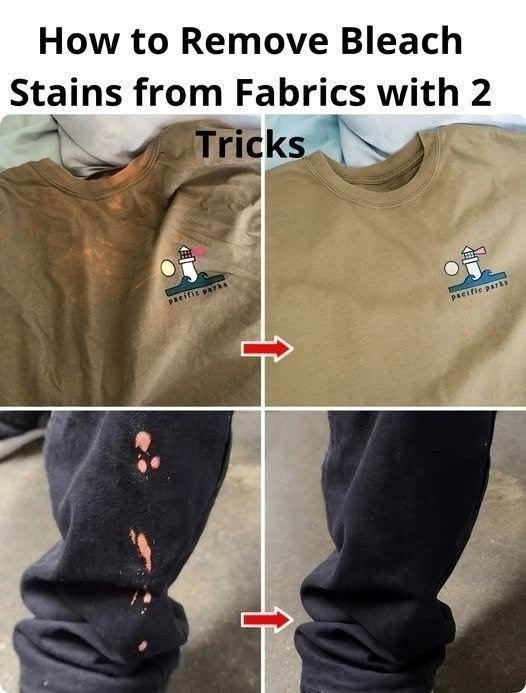
Bleach stains can be incredibly frustrating because household chlorine bleach does not simply coat a fabric—it undergoes a chemical reaction that permanently strips the dye away, leaving behind a bare white, yellow, or reddish patch.
Because the color pigment is physically gone rather than just stained, standard laundry washing will not restore it. However, you can use two effective chemical and color-restoration techniques to salvage bleach-damaged garments depending on the fabric type and color.
Here is an objective, practical guide to the two simplest tricks for fixing bleach stains at home:
Trick 1: The Rubbing Alcohol Method (Best for Dark/Black Fabrics & Small Spots)
This technique works by using a solvent to solubilize the intact dye in the surrounding, undamaged fabric fibers and pulling that color over into the bleached area.
When to Use
-
Best for small bleach spots or splatters on dark items (black, navy, dark blue, or dark gray).
-
Works best on natural fibers like cotton, linen, or wool.
Step-by-Step Instructions
-
Apply the Alcohol: Soak a cotton ball or swab with standard rubbing alcohol (isopropyl alcohol).
-
Rub from the Outside In: Lightly rub the soaked cotton ball on the colored fabric directly surrounding the bleach spot, then gently dab inward toward the white patch.
-
Transfer the Dye: As the alcohol dissolves a small amount of the surrounding dye, continue dabbing it into the center of the bleached area until the bare spot is covered.
-
Air Dry: Allow the fabric to air dry completely. The spot should blend smoothly into the surrounding material.
Trick 2: Re-Dyeing with Fabric Markers or Dye Baths (Best for Large Spots & Vibrant Colors)
When the bleach patch is too large for dye transfer—or if the fabric is brightly colored—replacing the lost pigment directly is the most reliable approach.
Option A: Fabric Markers (Quickest for Medium Spots)
-
How It Works: Permanent fabric markers are specifically formulated to bond with textile fibers without washing out in the laundry.
-
The Action: Select a fabric marker that closely matches the original garment color. Color in the bleached spot carefully, starting with a lighter layer. Use a clean cloth or finger to blend the edges into the surrounding fabric while the ink is wet. Allow it to set according to the marker package instructions.
Option B: Full-Garment Dye Bath (Best for Extensive Damage)
-
How It Works: Immersing the entire garment in a fiber-reactive dye (such as Rit Dye) re-pigments the entire piece uniformly.
-
The Action: First, neutralize any leftover active bleach on the fabric by rinsing the spot with a solution of 1 tablespoon sodium thiosulfate (or hydrogen peroxide) mixed in 1 cup of water. Next, prepare a fabric dye bath according to the manufacturer’s instructions for your fabric type (cotton vs. synthetic) and submerge the entire item to restore a uniform color.
Important Safety and Pre-Treatment Tips
-
Neutralize active bleach immediately: If the bleach stain just happened, flush the area under cold running water right away. Active bleach will continue to weaken and rot fabric fibers over time if left untreated.
-
Avoid mixing chemicals: Never combine bleach with ammonia or vinegar, as this releases toxic chloramine or chlorine gas. Always work in a well-ventilated area when using rubbing alcohol or dye solutions.
