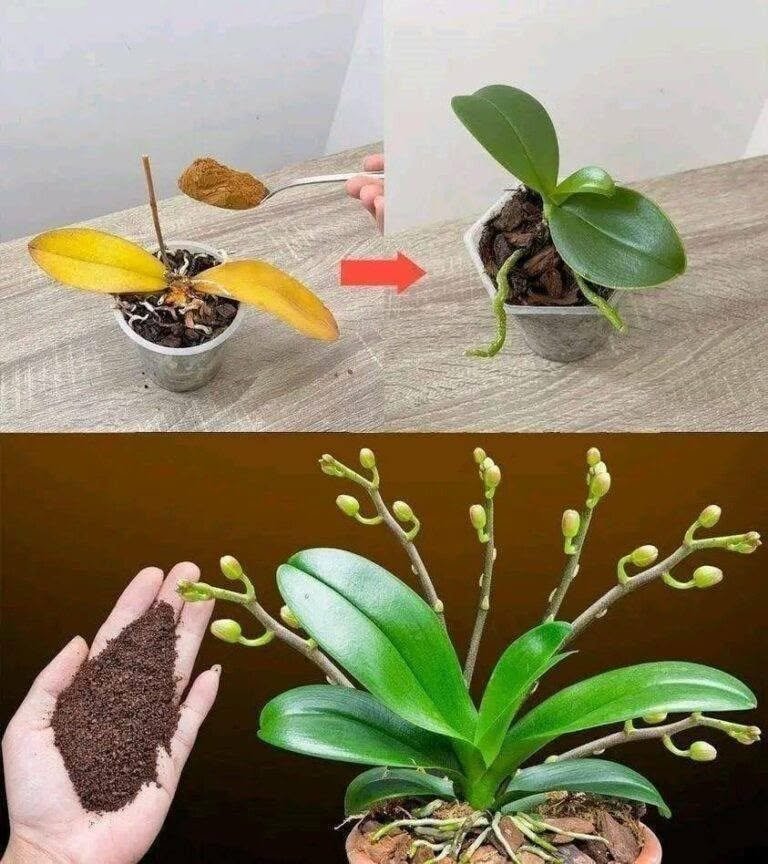
The “teaspoon trick” for orchids is a popular viral trend across online gardening communities. Videos often feature simple household additives—such as Epsom salt, crushed eggshells, cinnamon, or dried garlic powder—promising an instant burst of flowers.
While household ingredients can offer minor benefits, the real trigger for orchid blooms is precise environmental control combined with balanced care.
Popular “Teaspoon” Remedies & Their Botanical Reality
1. Magnesium Sulfate (Epsom Salt)
-
The Claim: 1 teaspoon of Epsom salt added to water triggers immediate flowering spikes.
-
Biochemical Reality: Magnesium aids chlorophyll production and enzyme activation. While it supports overall metabolic health in magnesium-deficient plants, it does not force blooming by itself.
2. Crushed Eggshell Powder
-
The Claim: 1 teaspoon sprinkled onto the bark medium acts as a miraculous bloom booster.
-
Biochemical Reality: Eggshells are primarily calcium carbonate. They break down extremely slowly in bark mediums, providing negligible immediate calcium to epiphytic orchids like Phalaenopsis.
3. Garlic or Cinnamon Powder
-
The Claim: 1 teaspoon protects roots and stimulates rapid flower spike formation.
-
Biochemical Reality: Garlic and cinnamon contain mild natural antifungal and antibacterial compounds. They can help protect cut surfaces or damaged roots, but they lack the macro-nutrients needed to generate flower spikes.
What Actually Triggers Orchids to Bloom
| Key Factor | Ideal Condition | Biological Impact |
| Temperature Drop | $10\text{–}15^\circ\text{F}$ drop at night for 2–3 weeks | Primary trigger that signals Phalaenopsis orchids to initiate a new flower spike. |
| Filtered Light | Bright, indirect sunlight (East window) | Essential for accumulating energy via photosynthesis required to produce flowers. |
| Balanced Fertilizer | Balanced N-P-K (e.g., 20-20-20) diluted to $\frac{1}{4}$ strength | Supplies available nitrogen, phosphorus, and potassium without burning delicate roots. |
| Proper Root Aeration | Coarse bark mixture; dry-out between waterings | Prevents root rot, maintaining healthy tissue capable of absorbing nutrients. |
Actionable Care Protocol for Reliable Blooms
-
Induce a Thermal Trigger: Place your orchid in a cooler room or near an open window during autumn nights ($55\text{–}65^\circ\text{F} / 13\text{–}18^\circ\text{C}$) for 2 to 3 weeks.
-
Apply Weak Weekly Fertilizer: Use a high-phosphorus “bloom booster” or balanced orchid fertilizer diluted to $\frac{1}{4}$ the recommended label strength during active growth cycles.
-
Inspect the Root System: Ensure roots are firm and silver-green (when dry) or dark green (when hydrated). Prune any mushy, brown roots before attempting to induce flowering.
This video demonstrates common household ingredient hacks—including teaspoon powder treatments—used by online gardeners attempting to stimulate root growth and flower spikes in orchids.
