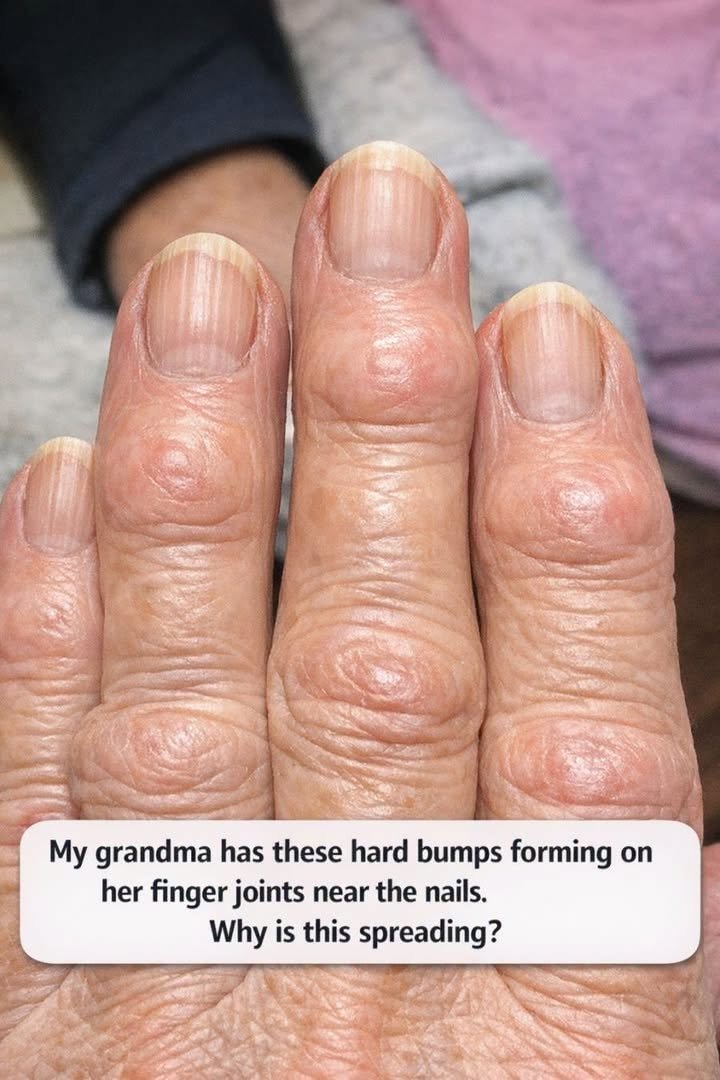
When hard bumps form on finger joints near the nails, people often worry that an illness is aggressively “spreading” across their hands. In reality, these bumps are almost always tied to localized wear-and-tear in the joints rather than a systemic or infectious disease moving through the body.
Depending on whether the bumps feel hard and bony or smooth and fluid-filled, they typically point to one of two common, related conditions:
1. Heberden’s Nodes (Bony Bumps)
If the bumps feel completely hard, bony, and fixed directly on the joint closest to the fingernail (known medically as the distal interphalangeal joint), they are likely Heberden’s nodes.
-
Why they happen: They are a classic physical sign of hand osteoarthritis. As the smooth cartilage inside the joint gradually wears down over time, the body responds by remodeling the bone, producing small, hard bony spurs (osteophytes) at the edges of the joint.
-
Why it looks like it’s “spreading”: Osteoarthritis frequently affects multiple fingers (often beginning on one hand and gradually appearing on corresponding joints of the other hand). Because it is a symmetrical, multi-joint wear-and-tear process, new nodes can appear to pop up sequentially over months or years.
2. Digital Mucous Cysts (Fluid-Filled Bumps)
If the bumps appear just between the final finger joint and the base of the fingernail and have a smooth, shiny, or slightly translucent look, they are frequently digital mucous cysts (a type of ganglion cyst).
-
Why they happen: These cysts are deeply connected to underlying joint arthritis. As minor wear-and-tear or pressure affects the joint capsule, joint fluid can leak out and form a small, jelly-filled sac under the skin near the nail matrix.
-
Why they can change or multiply: Because they share a pathway with the joint space, they can fluctuate in size or recur if the underlying joint pressure isn’t addressed.
What You Should Not Do
-
Never try to pop, squeeze, or drain a mucous cyst at home. Because the skin covering them near the nail is very thin, puncturing them creates a direct doorway for bacteria from the skin surface to enter the joint, which can lead to a severe, painful deep joint infection (septic arthritis).
Next Steps and Management
While these bumps are generally benign features of joint wear-and-tear, a physician or a hand specialist can evaluate them accurately—often using a simple physical exam or an X-ray to check the health of the underlying joint. Treatment focuses on managing any discomfort, protecting joint mobility, or addressing cysts if they interfere with the nail growth or cause persistent irritation.
