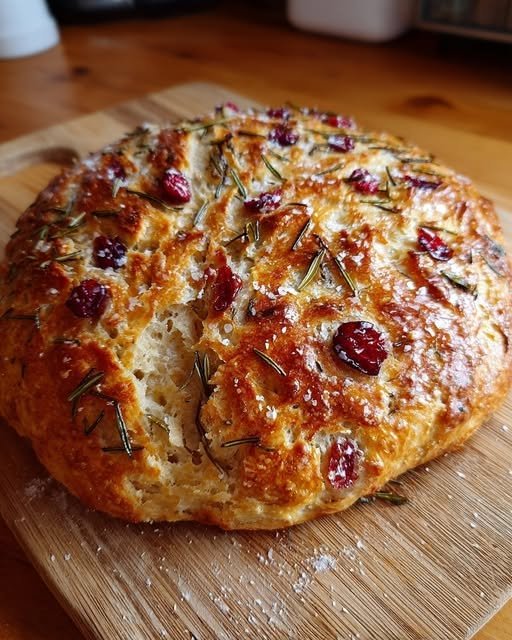
No-Knead Rosemary Cranberry Bread with Olive Oil & Sea Salt!

When you want artisan bakery-quality bread with a shatteringly crisp crust and a tender, open crumb—without spending hours kneading dough—No-Knead Rosemary Cranberry Bread is an absolute masterpiece.

By combining a high-hydration dough with a long, slow fermentation process, this recipe lets time do the work for you. The floral, earthy notes of fresh rosemary pair exquisitely with the tart bursts of dried cranberries, all balanced by a generous drizzle of olive oil and flaky sea salt.

The Culinary Secret: Time and Steam

Traditional bread requires vigorous kneading to build gluten strands. No-knead bread relies on autolysis and enzymatic activity:
  • The Long Rise: Leaving the wet dough covered at room temperature for 12 to 18 hours allows gluten to develop naturally as the yeast works.
  • The Dutch Oven Effect: Baking the bread inside a preheated heavy-bottomed Dutch oven traps the moisture released by the dough, creating an internal steam chamber. This keeps the crust gelatinized and soft long enough for the loaf to achieve maximum oven spring before setting into a gorgeous, crunchy crust.

No-Knead Rosemary Cranberry Bread Recipe

  • Prep time: 15 minutes (+ 12–18 hours resting time)
  • Bake time: 45 minutes
  • Yields: 1 rustic round loaf (boule)

Ingredients

  • 3 cups unbleached all-purpose flour (or bread flour for a chewier crumb)
  • 2 teaspoons kosher salt or fine sea salt
  • $\frac{1}{4}$ teaspoon active dry yeast or instant yeast
  • $1\frac{1}{2}$ cups lukewarm water
  • $\frac{1}{2}$ cup dried cranberries
  • 2 tablespoons fresh rosemary leaves, finely chopped
  • 2 tablespoons extra-virgin olive oil (plus extra for drizzling)
  • Flaky sea salt (like Maldon) for finishing
1.Mix the Dry Ingredients:Whisk flour, salt, yeast, cranberries, and rosemary together.

In a large bowl, whisk together the flour, salt, yeast, dried cranberries, and chopped fresh rosemary until thoroughly combined.
2.Combine with Wet Ingredients:Stir water and olive oil into a shaggy, wet dough.

Pour in the lukewarm water and 2 tablespoons of olive oil. Stir with a wooden spoon or silicone spatula just until a sticky, shaggy dough forms and no dry flour remains. (Do not knead—it should look messy!)
3.The Long Ferment:Cover tightly and let ferment at room temperature for 12 to 18 hours.

Cover the bowl tightly with plastic wrap or a damp towel. Let it sit undisturbed at room temperature for 12 to 18 hours. You will know it is ready when the surface is bubbly and dotted with air pockets.
4.Shape the Boule:Shape into a tight round ball on a heavily floured surface.

Generously flour your hands and a work surface. Gently deflate the dough and turn it out. Fold the edges toward the center to form a round ball (boule). Place the dough seam-side down on a sheet of parchment paper, dust the top lightly with flour, cover loosely, and let rest for 30 to 45 minutes while your oven heats.
5.Preheat the Dutch Oven:Preheat your heavy pot inside the oven at 450°F.

Place a heavy cast-iron Dutch oven (with its lid on) onto the middle rack of your oven and preheat to $450^\circ\text{F}$ ($230^\circ\text{C}$) for at least 30 minutes.
6.Bake to Crusty Perfection:Bake covered for 30 minutes, then uncovered for 15 minutes.

Carefully lift the dough using the parchment paper corners and lower it straight into the scorching hot Dutch oven. Cover with the lid and bake for 30 minutes. Then, remove the lid, drizzle the top with a little olive oil and flaky sea salt, and bake uncovered for another 12 to 15 minutes until the crust is deeply golden brown and crisp. Cool completely on a wire rack before slicing.

Serving Suggestions

This bread is a sensory delight on its own, but it truly shines when paired with:
  • Whipped honey butter or a sharp white cheddar.
  • Alongside a warm bowl of creamy autumn squash or tomato soup.

Leave a Comment