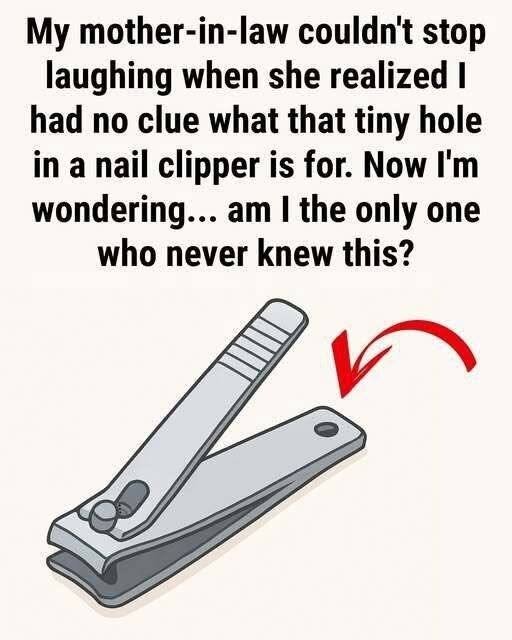
Have you ever looked closely at a standard fingernail clipper and wondered about the tiny, seemingly random circular hole punched through the end of the lever?
It looks like a manufacturing detail or a spot meant for a keychain, but that little hole actually serves a remarkably clever mechanical purpose—both in how the tool is made and how it is used.
Here is why that small round hole is there and why it remains surprisingly useful today:
1. The Manufacturing Secret: Holding the Rivet in Place
From an engineering standpoint, that hole is a relic of how traditional clippers are assembled.
-
During manufacturing, the metal lever, the base, and the cutting head are held together by a central metal pin (the rivet).
-
In many classic designs, the hole at the end of the lever was used by factory machinery to hook, align, or secure the pivoting arm precisely while the rivet was crimped or heat-treated into place. Without that anchor point, mass-producing the precise tension needed for the clipper to snap cleanly would be much harder.
2. The Practical Modern Use: Threading a Keychain or Lanyard
While factories used it for assembly, everyday users quickly realized it makes a perfect attachment point.
-
Because nail clippers are notoriously easy to lose in the bottom of a dopp kit, drawer, or travel bag, threading a small split ring through that hole allows you to attach the clipper to a keychain, a multi-tool, or a toiletry zipper pull.
-
It keeps the tool secure and ensures you always know where it is when you need it.
3. A Makeshift Sewing or Emergency Repair Anchor
Decades ago, when sewing kits and repair tools were more frequently carried on the go, that tiny hole had another hidden utility: anchoring a thread.
-
In a pinch, the hole can double as a tiny eyelet to anchor a heavy-duty thread or cord if you need to use the lever’s metal edge or leverage to pull something tight, though this is rarely needed today.
The Takeaway: That small hole is a brilliant example of functional design—serving a vital role on the factory floor during production while offering a convenient way to keep track of a tiny, easily misplaced tool in daily life.
