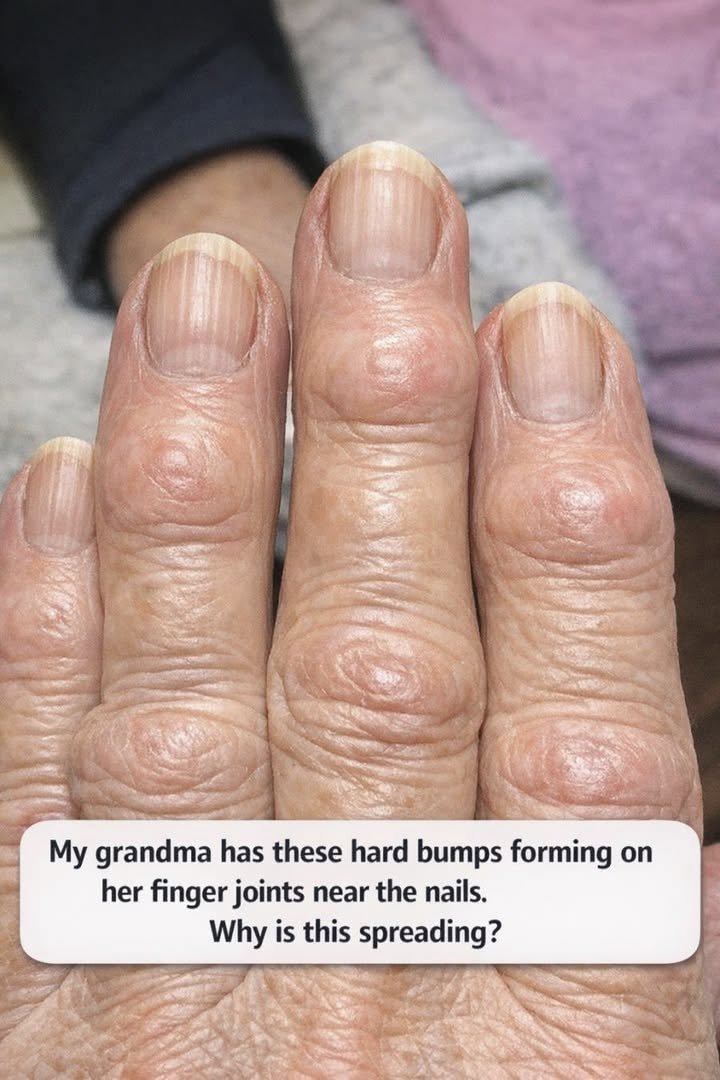
When hard, bony, or dome-shaped bumps form on the finger joints closest to the nails, they are most commonly Heberden’s nodes or mucous cysts (myxoid cysts). Both conditions are closely tied to underlying joint wear and tear rather than an infectious or contagious process.
What These Bumps Typically Represent
-
Heberden’s Nodes (Bony Spurs):
-
The Mechanism: When osteoarthritis affects the hands, it frequently targets the distal interphalangeal (DIP) joints—the knuckles right next to the fingernails. As the smooth cartilage protecting the ends of the bones gradually thins over time, the body responds by laying down new bone at the joint edges to stabilize it. These small, hard bony growths are called Heberden’s nodes.
-
-
Mucous Cysts (Fluid-Filled Bumps):
-
The Mechanism: Sometimes, the joint changes associated with hand arthritis allow joint fluid to escape into the surrounding tissue, forming a small, smooth, dome-shaped sac right near the nail bed. Because these cysts often press against the tissue matrix where the nail grows, they can sometimes cause a small ridge or lengthwise groove to form in the fingernail itself.
-
Why It Appears to Be “Spreading”
It can feel alarming when multiple bumps appear across different fingers, making it look like an active infection or a spreading disease. However, hand osteoarthritis is a generalized, systemic wear-and-tear process rather than a localized or infectious illness. Because genes, natural aging, and mechanics affect multiple similar joints across both hands, nodes and cysts frequently develop gradually on one finger after another over months or years, creating the impression that the condition is spreading.
Safe Management and Next Steps
-
Never Attempt to Pop or Drain Them: If a bump is a mucous cyst, attempting to puncture or squeeze it at home is dangerous. Because the cyst communicates directly with the joint capsule, breaking the skin can easily introduce bacteria and trigger a severe, deep-seated joint infection.
-
Seek a Professional Evaluation: A primary care physician, rheumatologist, or hand specialist can easily evaluate the fingers—often through a physical exam or an X-ray—to confirm whether the bumps are osteoarthritic nodes or cysts.
-
Focus on Comfort and Protection: If the joints are occasionally achy or inflamed, gentle heat therapy, topical anti-inflammatory gels, or protective splinting during flare-ups can help manage discomfort while maintaining hand function.
