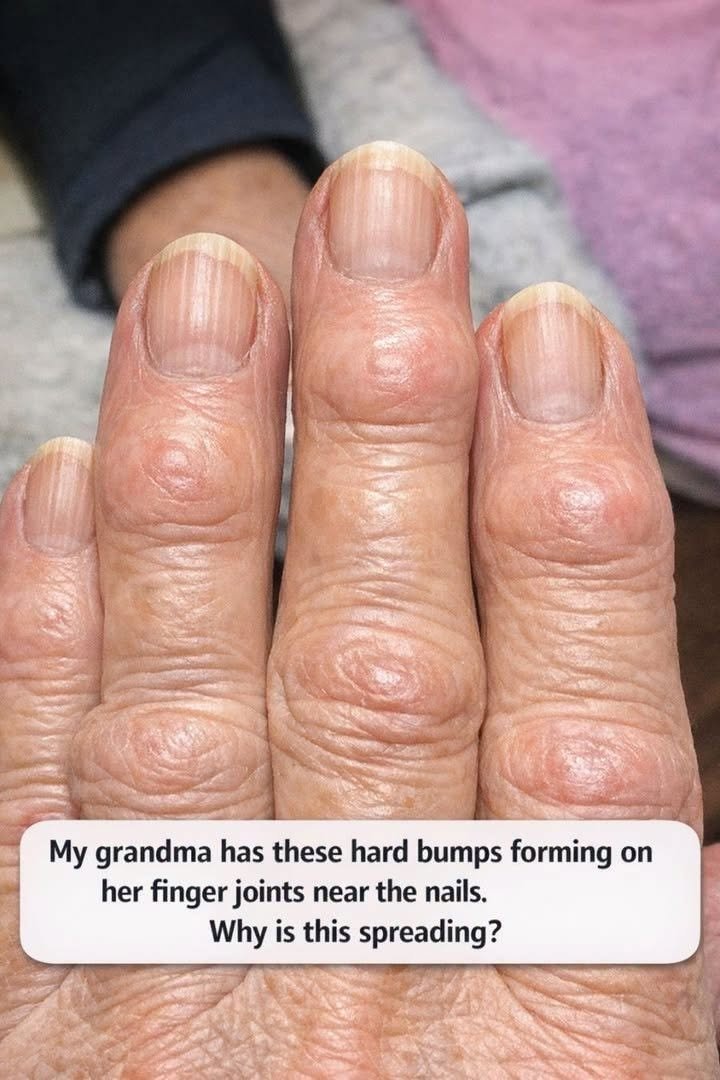
When hard bumps form on the finger joints right near the nails, they are most commonly Heberden’s nodes (bony growths) or digital mucous cysts (fluid-filled sacs), both of which are strongly linked to hand osteoarthritis.
Why It Appears to Be “Spreading”
If it looks like the bumps are spreading from one finger to another, it is usually due to the natural progression of hand osteoarthritis. Osteoarthritis is a degenerative wear-and-process affecting joint cartilage. Because hand usage patterns, genetics, and joint stress affect multiple digits similarly, the condition frequently develops across several fingers over months or years—starting on one finger and gradually appearing on adjacent ones.
The Two Most Likely Culprits
-
Heberden’s Nodes (Bony Spurs):When the cartilage inside the joint closest to the fingertip (the distal interphalangeal joint) wears down, the body responds by laying down extra bone at the edges to stabilize the joint. These form hard, fixed, bony lumps that do not move under the skin. While they can look alarming or cause stiffness, the active inflammation and tenderness often settle down over time.
-
Digital Mucous Cysts:These are small, smooth, gel-filled ganglion cysts that develop right next to the nail bed or near that same end joint, often connected by a tiny stalk to an arthritic joint. Because they sit right under the nail matrix, they can sometimes press on the growing nail and cause a visible ridge or groove.
Next Steps for Care
-
Get an Accurate Diagnosis: Have your grandmother’s primary care physician or a hand specialist examine her hands. They can easily differentiate between bony osteoarthritis nodes, cysts, or other inflammatory joint conditions through a physical assessment or an X-ray.
-
Avoid Home Interventions: If a bump turns out to be a mucous cyst, never attempt to squeeze, pop, or drain it at home, as this can introduce bacteria and lead to a deep joint infection.
-
Support Joint Comfort: Gentle hand exercises, occupational therapy, warm compresses, or topical anti-inflammatory gels can help maintain mobility and ease any discomfort during active flare-ups.
