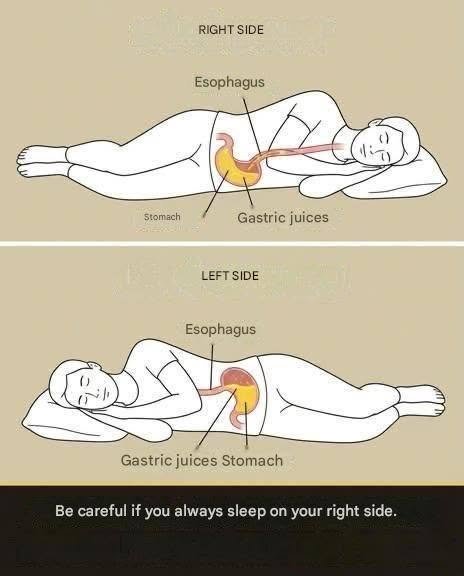
When clickbait health articles tease that “if you always sleep on your right side, you…”, they rely on alarmist framing to turn a normal physical resting posture into an impending medical disaster.
The underlying physiological reality is far more mundane: the human body naturally shifts and adjusts positions dozens of times a night, and sleeping on your right side is a completely normal, common sleeping posture. While sleeping posture can influence specific health conditions like acid reflux or cardiovascular comfort, a blanket warning against side sleeping ignores how your body self-regulates during rest.
An evidence-based look at what side sleeping actually does to your body separates internet scare tactics from sleep science.
The Real Physiology of Right-Side Sleeping
Different sleeping positions offer distinct mechanical advantages and drawbacks depending on your underlying health profile:
-
Acid Reflux (GERD): Anatomically, the stomach sits on the left side of the upper abdomen, and the junction where the esophagus meets the stomach lies slightly above the gastric acid level when you lie on your left side. Sleeping strictly on your right side can relax the lower esophageal sphincter and allow stomach acid to pool more easily, potentially triggering heartburn for those with chronic GERD. (Conversely, left-side sleeping uses gravity to keep acid safely contained).
-
Cardiovascular Comfort: For most healthy people, sleeping on either side has minimal impact on the heart. However, individuals with specific forms of heart failure sometimes report feeling more comfortable or experiencing less palpitations on their right side, as gravity prevents the heart from shifting awkwardly against the chest wall (though left-side sleeping is often recommended for pregnant individuals to optimize blood flow to the fetus).
-
Skin and Wrinkle Formation: Pressing one side of your face against a pillow night after night creates mechanical compression and friction, which can gradually contribute to sleep lines and facial wrinkles over decades—though this affects left- and right-side sleepers equally.
Why Blanket Sleep Warnings Fail
The human body is not a static machine that locks into a single posture for eight hours. Natural movement during sleep is a sign of healthy neuromuscular function:
-
Positional Shifts: We instinctively change positions throughout the night to relieve pressure points, optimize circulation, and prevent muscle stiffness.
-
The Body Self-Corrects: If a specific position causes discomfort, restricted breathing, or acid reflux, your autonomic nervous system prompts you to roll over long before any permanent harm occurs.
The Takeaway
Ignore the sensational warnings about your preferred sleep posture. Unless you suffer from specific medical conditions like severe acid reflux—where left-side sleeping offers a proven anatomical advantage—sleep on whatever side allows you to rest comfortably and wake up pain-free.
