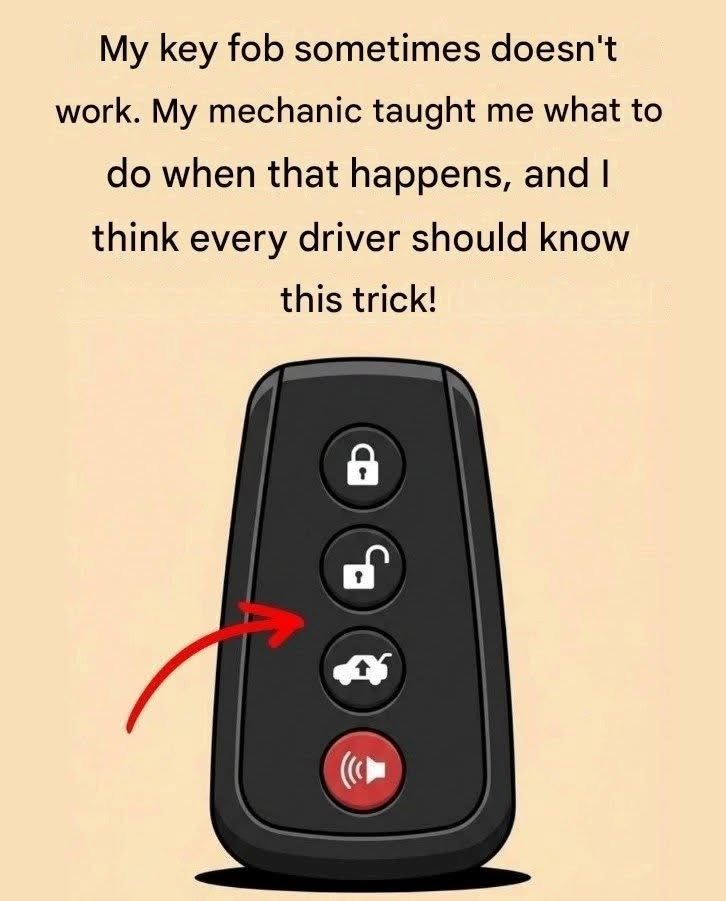
When viral automotive reels and social media clips promise miraculous tricks like “Try these hacks when your key fob stops working,” they usually mix old wives’ tales with a surprising grain of genuine physics. While some online shortcuts are pure internet folklore, others tap into real radio-frequency science.
What Clickbait “Key Fob Hacks” Get Wrong vs. What’s Real
-
The “Magic Battery Recharging” Fallacy: Videos claiming you can completely revive a dead coin-cell battery by rubbing it on your clothes or warming it in your hands rely on false hope. While friction or warmth can cause a tiny, temporary voltage fluctuation in a dying lithium cell, it cannot restore depleted chemical reactants.
-
The “Chin Antenna” Phenomenon (The Surprising Truth): Unlike most gimmicks, the widely shared trick of holding your key fob up to your chin or temple to dramatically boost its range is actually real.
The Science Behind the Head-to-Chin Trick
Radio Frequency Keyless Entry (RKE) fobs use tiny internal loop antennas designed to fit inside a pocket, which makes them inherently inefficient at long-range transmission.
When you press the fob against your chin or head, the high water content and conductive tissue of the human body act as a capacitive coupler and a proxy ground plane. This alters the electromagnetic radiation pattern, effectively turning your skull into a temporary antenna reflector that amplifies and projects the signal further—doubling or even tripling your operational range.
Real, Evidence-Based Troubleshooting When a Fob Fails
When your key fob genuinely stops responding, bypassing internet myths in favor of mechanical troubleshooting is the most reliable approach:
-
Inspect and Replace the Battery: The most common cause of failure is a weakening CR2032 or CR2025 lithium coin cell. If your car requires multiple button presses or only responds from close range, swap out the battery.
-
Locate the Hidden Physical Blade: Almost all modern electronic smart keys conceal a physical metal key inside the plastic housing. Slide the release latch to expose the blade, which can open the driver-side door lock manually when electronic systems fail.
-
Use the Emergency RFID Backup for Push-to-Start: If your car has a push-button ignition and won’t start because the fob battery is completely dead, the vehicle usually features a backup near-field communication (NFC/RFID) zone. Holding the key fob directly against the start button—or placing it in a designated slot inside the center console—allows an unpowered chip inside the fob to communicate with the vehicle’s immobilizer system.
For a quick look at how the body-antenna effect works in practice, you can watch this demonstration of the key fob range trick. This video provides a brief visual breakdown of how positioning the remote near conductive surfaces can alter signal transmission.
