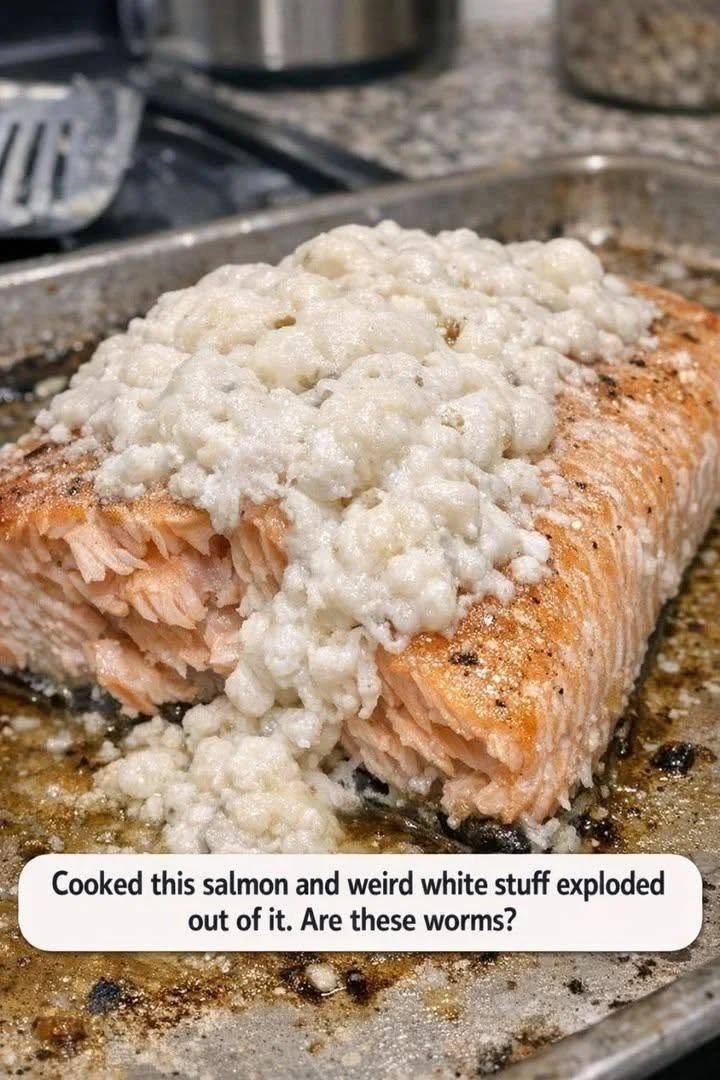
When food blogs or viral social media posts ask, “What is the white stuff coming out of cooked salmon? Is it worms or something else?” they love to exploit a genuinely unsettling visual with gross-out clickbait. There is nothing quite as alarming as pulling a beautiful piece of fish out of the oven only to see it covered in mysterious white ooze.
In culinary and biological reality, that white stuff is not parasites, worms, or chemical additives. It is an entirely natural, harmless protein called albumin.
What Exactly Is Albumin?
Albumin is a protein naturally present in the raw muscles of fish and animals (similar to the clear white part of an unbaked chicken egg).
-
How It Appears: Inside the raw fish, albumin exists in liquid form, held within the muscle fibers. When you apply heat, those muscle fibers contract and tighten up.
-
The Squeezing Effect: As the fish cooks, especially if the heat is high or rapid, the muscle contracts forcefully and pushes the liquid moisture—and the dissolved albumin along with it—out toward the surface. Once it hits the heat of the air or pan, the protein coagulates and turns white and solid, exactly like an egg white cooking in a skillet.
Why Do Some Fillets Seem to Produce More?
If you have ever noticed that one piece of salmon turns completely frosty white while another stays clean, it usually comes down to a few simple factors:
-
Cooking Speed: Cooking salmon over high, aggressive heat forces the muscle fibers to contract too quickly, squeezing out much more albumin. Gentle, moderate-heat cooking minimizes this effect.
-
Moisture and Storage: Fish that have lost more moisture during storage or freezing tend to release albumin more readily.
-
The Cut of the Fish: Thicker fillets or cuts from certain regions of the fish have different fat and muscle distributions, altering how fluid moves under heat.
Simple Ways to Minimize Albumin
While the white stuff is entirely edible, safe, and flavorless, you can easily reduce or prevent it for a cleaner presentation:
-
Lower the Heat: Bake or sear your salmon at a slightly lower, more moderate temperature (around 350 to 400 degrees Fahrenheit rather than blasting it under a high broiler).
-
Brine the Fish First: Soaking your salmon fillets in a simple salt-and-water solution (about 1 tablespoon of salt per cup of water) for 15 to 20 minutes before cooking dissolves a small amount of surface muscle protein, creating a protective matrix that largely keeps albumin trapped inside.
The Bottom Line
That white stuff on your cooked salmon is just harmless protein doing what proteins do when heated. It looks a bit strange, but it has zero impact on safety or taste.
