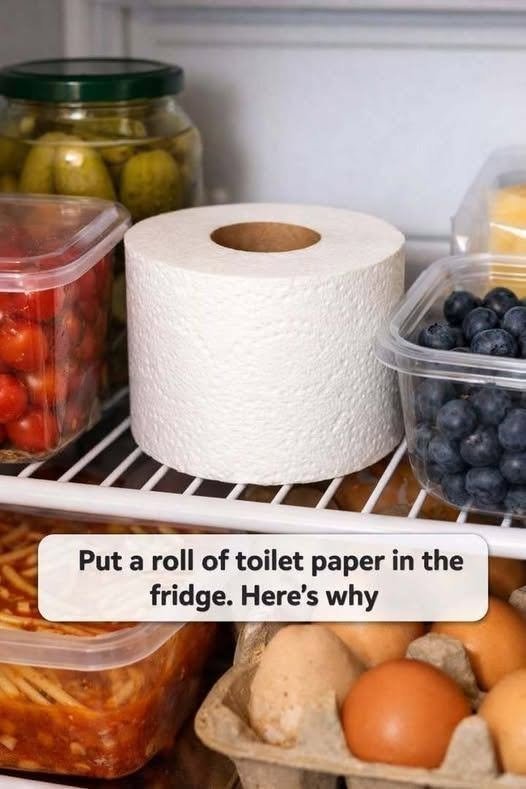
When viral lifestyle blogs and social media feeds push bizarre hooks like “Put a roll of toilet paper in the fridge. Here’s why,” they are relying on a classic internet formula: taking a mundane household item, framing it as a secret life hack, and injecting an element of absurd novelty to drive clicks.
While dropping a roll of paper next to your leftover lasagna might make for an entertaining video, it is far from an optimal solution for household maintenance.
What Clickbait “Fridge Hack” Myths Get Wrong
-
The “Magic Deodorizer” Exaggeration: Clickbait articles treat a roll of toilet paper like an advanced, high-tech air filtration system, ignoring the fact that it is fundamentally just compressed wood pulp.
-
Overlooking Kitchen Hygiene: Storing an unsealed, highly absorbent paper product in a damp, food-storage environment means it actively pulls in moisture, food particles, and ambient humidity—raising questions about cleanliness when you eventually move that paper back to the bathroom.
The Practical Reality: How Cellulose Actually Behaves
Appliance experts, chemists, and food safety professionals look at this viral trend through the lens of material science and basic physics:
-
Passive Absorbency vs. Chemical Neutralization: Toilet paper is made of porous cellulose fibers designed to absorb liquids. In a refrigerator, those microscopic pores can trap a minor amount of ambient moisture and floating volatile organic compounds (the molecules responsible for smells). However, unlike baking soda (sodium bicarbonate), which chemically neutralizes acidic odor molecules, toilet paper merely traps them physically on a temporary basis.
-
Rapid Saturation and Sogging: Because refrigerators are high-humidity environments designed to keep food fresh, an unprotected roll of paper will quickly absorb moisture from the air and nearby produce. Once the paper becomes damp, its capacity to trap additional odor molecules drops sharply, and it risks becoming a breeding ground for mildew or mold.
-
Better, Purpose-Built Alternatives: If your goal is to combat fridge odors, science-backed solutions outperform bathroom supplies every time. An open box of baking soda neutralizes acids, while activated charcoal uses massive surface-area adsorption to trap odor particles efficiently without taking on excess moisture or looking bizarre to houseguests.
The Bottom Line
You don’t need to raid the bathroom cabinet to keep your refrigerator smelling fresh. Skip the viral internet gimmicks, keep your paper products where they belong, and use traditional, inexpensive tools like baking soda or activated charcoal to manage fridge odors safely.
