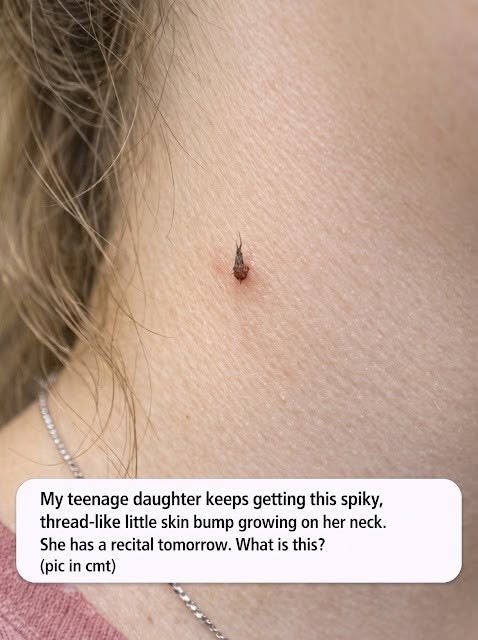
When patients or parents notice a small, elongated, or frond-like growth on the neck—often described as a spiky, thread-like bump—dermatologists typically evaluate it within a clear clinical framework. Rather than guessing based on online anecdotes, a proper medical assessment distinguishes between a few common, benign skin findings.
Potential Clinical Explanations
-
Filiform Warts (Verruca Filiformes)
-
What They Are: Filiform warts are a distinct subtype of common warts caused by specific strains of the human papillomavirus (HPV).
-
Appearance: They feature long, narrow, finger-like or thread-like projections that stick out vertically from the skin’s surface. Because they grow outward rapidly, they can feel rough, spiky, or bristle-like to the touch. They commonly appear on the face, eyelids, lips, and neck.
-
Transmission: Like other cutaneous warts, they are contagious and can spread via direct skin-to-skin contact or autoinoculation (such as scratching or shaving, which can transfer the virus to adjacent skin).
-
-
Skin Tags (Acrochordons)
-
What They Are: Skin tags are soft, noncancerous growths composed of loose collagen fibers and blood vessels.
-
Appearance: While typical skin tags are smooth and round, some variants can take on a narrow, pedunculated, or thread-like shape (sometimes medically termed filiform skin tags), particularly in high-friction areas like the sides and back of the neck. They are completely harmless and non-contagious.
-
Why Professional Evaluation Matters
Attempting to diagnose or remove neck lesions at home can lead to unnecessary complications:
-
Infection and Irritation: Picking, pulling, or applying harsh over-the-counter chemical treatments (like strong acid-based wart removers or unverified folk remedies) to sensitive neck skin can cause chemical burns, secondary bacterial infections, or permanent scarring.
-
Accurate Differentiation: A dermatologist can quickly examine the bump under magnification to confirm whether it is a viral wart, a skin tag, or another benign lesion, ensuring the right management plan.
Professional Treatment Options
If a filiform wart or bothersome skin tag requires removal for comfort, irritation (such as catching on clothing or jewelry), or cosmetic reasons, a physician or dermatologist can utilize precise clinical methods:
-
Cryotherapy: Controlled application of liquid nitrogen to freeze and destroy the lesion tissue safely.
-
Electrosurgery or Cautery: Using a specialized medical device to gently remove or seal the growth under appropriate clinical conditions.
-
Surgical Excision: Carefully trimming or shaving the lesion using sterile instruments.
