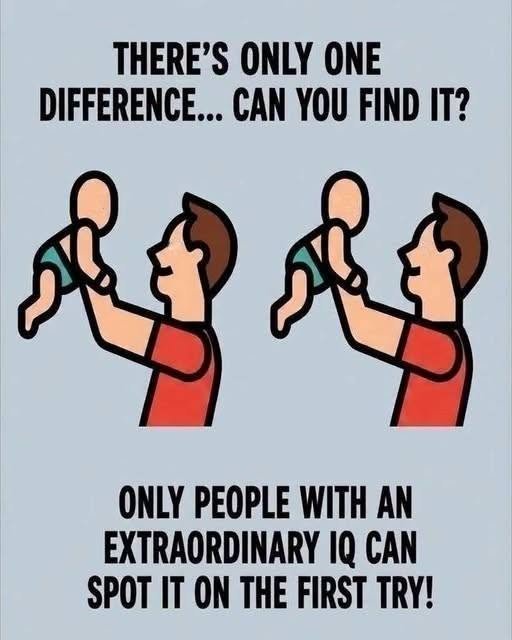
Optical illusions, visual puzzles, and perceptual challenges that claim to test high IQ often rely on the distinct way the human brain processes complex visual data. While these teasers are popular entertainment, the science behind how the brain perceives hidden figures, hidden patterns, and optical anomalies reveals fascinating aspects of human cognition and visual processing.
1. The Visual Science Behind “Spotting the Hidden Figure”
When you look at a dense, repetitive image—such as a grid of letters containing a single typo, a field of identical animals with one subtle variation, or a hidden geometric shape—your brain engages two primary processing pathways:
Top-Down vs. Bottom-Up Processing
-
Bottom-Up Processing: Your visual cortex receives sensory input directly from the eyes (lines, contrast, color, and texture) and attempts to build an overall picture from scratch. This is a slower, item-by-item search.
-
Top-Down Processing: Your brain uses past experience, expectations, and pattern recognition to predict what should be in the image. It effectively “smooths over” subtle anomalies to save mental energy.
To spot a subtle visual anomaly on the first try, your brain must temporarily bypass its top-down shortcut—which automatically assumes the pattern is uniform—and engage rapid, high-detail bottom-up analysis.
2. Common Types of High-Level Visual Puzzles
Visual intelligence challenges generally fall into four distinct neurological categories:
A. Pattern Disruption (The “Find the Odd One Out” Test)
-
How It Works: Dense grids filled with repeating symbols (e.g., hundreds of
8s with a hidden9, or dozens of smiling faces with one unsmiling face). -
The Cognitive Challenge: The brain’s visual system relies on grouping laws (Gestalt psychology). When items are uniform in color and size, the brain groups them into a single texture rather than treating each symbol as an individual object. Overcoming this requires breaking the texture down into isolated focal points.
B. Camouflage and Figure-Ground Segregation
-
How It Works: Images where a hidden object or animal blends seamlessly into its background (e.g., a leopard hidden in dry brush or a hidden face within a landscape drawing).
-
The Cognitive Challenge: This tests figure-ground perception—the ability of the brain to separate an object (the figure) from its surrounding environment (the ground). High spatial intelligence allows individuals to quickly identify contour lines and micro-contrasts that signal the boundary of a hidden object.
C. Optical Illusions and Impossible Objects
-
How It Works: Shapes that defy three-dimensional physics or illusions where static lines appear to move, warp, or change length.
-
The Cognitive Challenge: These exploit the latency between when light hits the retina and when the brain processes the image (roughly 100 milliseconds). The brain “predicts” the future movement or depth based on lighting shadows, creating an illusion that misleads standard depth perception.
D. Lateral Thinking and Mental Rotation
-
How It Works: Abstract 3D blocks or unfolded geometric shapes where you must identify which rotated variation matches the target.
-
The Cognitive Challenge: This directly taps into spatial working memory within the parietal lobe, requiring the mental manipulation of objects across spatial planes.
3. IQ, Cognitive Traits, and Visual Speed
While visual puzzles are often marketed as definitive IQ tests, performance on a single visual challenge is actually a measure of specific cognitive sub-skills rather than overall intelligence:
-
Processing Speed: How quickly the visual cortex can scan and register tiny differences in contrast or geometry.
-
Selective Attention: The ability to tune out vast amounts of irrelevant visual information while searching for a tiny, specific anomaly.
-
Spatial Reasoning: The capacity to visualize spatial relationships and perceive subtle differences in form, angle, and line orientation.
-
Visual Acuity: Basic physical eyesight, contrast sensitivity, and light absorption on the retina.
4. Proven Strategies to Spot Hidden Details Instantly
If you want to improve your speed and accuracy on visual challenges, cognitive scientists suggest using these systematic visual search techniques:
-
Invert Your Scanning Order: Most people scan images from top-left to bottom-right (matching reading habits). Scanning from bottom-right to top-left forces the brain out of its passive reading mode, sharpening attention to raw details.
-
Defocus and Refocus (Soft Focus): Unfocus your eyes slightly to blur fine details and observe the overall texture. Anomalies, misalignments, or line breaks will often appear as subtle “glitches” or dark spots in your peripheral vision.
-
Divide the Image into Grids: Mentally divide the visual field into four quadrants and scan each quadrant independently to prevent your eyes from jumping frantically across the image.
-
Look for Disruptions in Light and Edge Contour: Instead of looking for the actual object, look exclusively for unexplained shadows, unexpected sharp angles, or breaks in continuous lines.
