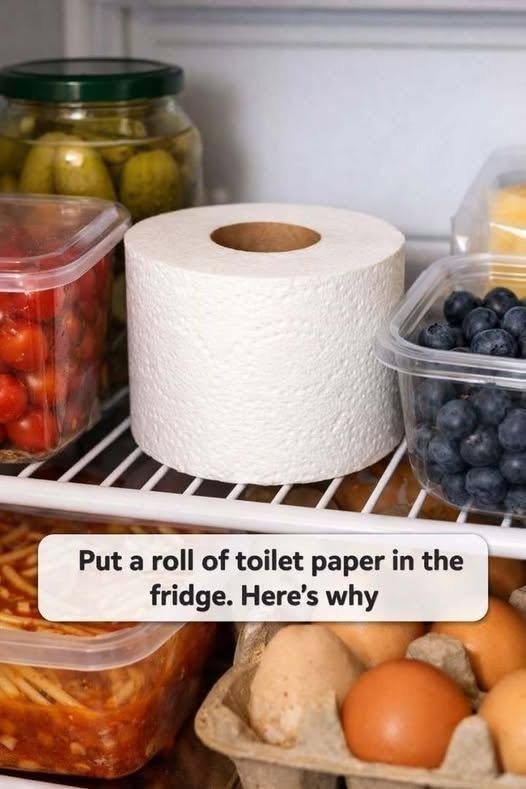
When viral life-hack videos and clickbait DIY sites urge you to “put a roll of toilet paper in the fridge,” they wrap a basic principle of chemistry in a bizarre, counterintuitive mystery designed purely to hook your curiosity.
The underlying scientific reality is much simpler: dry paper is an exceptionally porous, fibrous material with a massive surface area, making it an efficient passive odor absorber. However, keeping a roll of bathroom tissue next to your leftover food is not a brilliant home-cleaning breakthrough—it is an unconventional, highly inefficient way to manage refrigerator smells.
An evidence-based look at what is actually happening when you put paper in the fridge separates internet life-hacks from practical kitchen science.
1. How It Works (The Science of Porous Absorption)
To understand why the hack “works” at all, you have to look at the material:
-
Cellulose Fibers: Toilet paper is made of loose, highly absorbent cellulose wood fibers.
-
Trapping Volatile Organic Compounds (VOCs): When pungent foods (like onions, cheese, or leftover fish) release volatile odor molecules into the sealed air of a refrigerator, those microscopic molecules collide with the massive surface area of the paper fibers and get trapped in the porous structure.
2. Why It Is an Impractical Kitchen Habit
While toilet paper can absorb some ambient moisture and odor, using it in a food storage environment has several major drawbacks:
-
It Absorbs Moisture Too Well: Refrigerators are humid environments. A roll of bathroom tissue sitting in the fridge will quickly absorb ambient moisture, making the paper soggy, structurally compromised, and a breeding ground for localized mold and bacterial growth if left too long.
-
Hygienic Concerns: Toilet paper is manufactured for bathroom use, not for food-adjacent environments. Storing an absorbent paper product in an open refrigerator exposes it to airborne food particles, condensation, and potential cross-contamination.
-
Low Efficiency: Compared to materials specifically engineered for odor neutralization, paper has a very limited capacity before it becomes saturated and stops working entirely.
What to Use Instead (Proper Refrigerator Odor Control)
If your refrigerator smells less-than-fresh, skip raiding the bathroom cabinet and use materials designed for the job:
-
Baking Soda (Sodium Bicarbonate): An open box of baking soda is chemically alkaline, meaning it actively neutralizes and binds with acidic odor molecules rather than just trapping them temporarily.
-
Activated Charcoal: Activated charcoal has undergone a specialized steam-activation process that creates a microscopic network of pores, giving it exponentially more surface area than paper to trap odors and moisture safely.
-
A Thorough Clean: The only permanent fix for fridge odors is removing the source—throwing out spoiled food and wiping down interior surfaces with warm, soapy water or a vinegar solution.
The Takeaway
Skip putting bathroom supplies in the kitchen. While a roll of toilet paper will technically catch some stray odors through sheer surface area, it quickly becomes a soggy, unhygienic mess. Stick to an open box of baking soda or activated charcoal to keep your refrigerator smelling clean.
