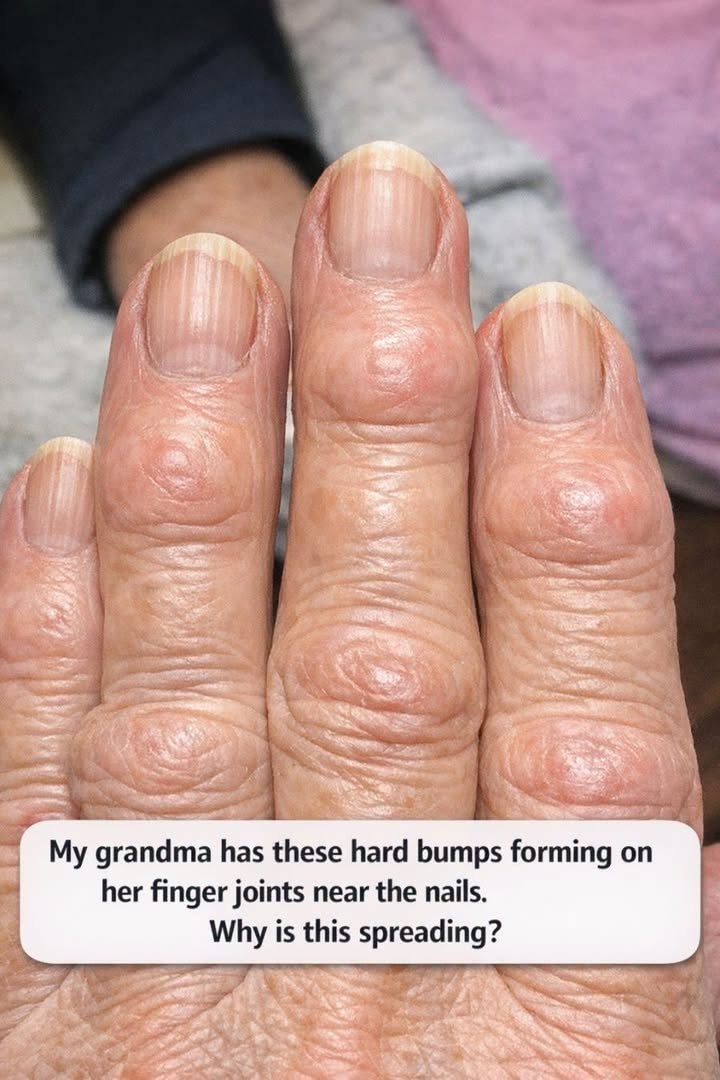
When older adults notice hard bumps forming on their finger joints—especially near the very ends of the fingers close to the nails—it is a very common physical observation. Rather than a mysterious infection or “spreading” disease, these hard nodules are usually related to normal wear-and-tear changes in the joints over time.
What Are Those Bumps?
When hard, bony bumps develop specifically on the joints closest to the fingernails (known clinically as the distal interphalangeal, or DIP, joints), they are most frequently Heberden’s nodes.
-
The Clinical Reality: These are small bony outgrowths (osteophytes) that form as a result of osteoarthritis—the gradual breakdown of cartilage cushioning the ends of the bones. Over time, the body attempts to repair the joint by laying down extra bone, which creates these hard, visible lumps.
-
Why They Seem to “Spread”: Osteoarthritis often affects multiple joints symmetrically across both hands. As the underlying joint wear progresses, nodules tend to appear on other fingers sequentially over months or years, making it look like the bumps are actively spreading when it is actually just the natural pattern of joint involvement.
Other Possibilities Doctors Consider
While Heberden’s nodes (or similar bumps on the middle joints called Bouchard’s nodes) are the most common cause, physicians evaluate a few other possibilities when examining finger nodules:
-
Mucous Cysts (Myxoid Cysts): These are small, fluid-filled lumps that often form right near the cuticle or the final joint, frequently associated with underlying arthritis in that same joint. They can sometimes look shiny or translucent.
-
Rheumatoid Nodules: Unlike osteoarthritis, rheumatoid arthritis is an autoimmune condition that can cause firm lumps under the skin, though these typically present with significant morning stiffness, warmth, and swelling across multiple different joint areas.
What You Should Do
-
Schedule an Evaluation: Have your grandma show these bumps to her primary care doctor or a rheumatologist. A physical examination—and sometimes a simple X-ray—can easily confirm whether they are classic osteoarthritic nodes or something else requiring specific management.
-
Support Joint Comfort: Gentle motion, warm water soaks, and anti-inflammatory care recommended by a physician can help manage any underlying joint discomfort or stiffness associated with the nodes.
The Bottom Line
Hard bumps near the finger joints are usually a familiar sign of age-related joint changes rather than a fast-spreading contagion. A proper medical check-up will give you a clear, reassuring diagnosis.
